

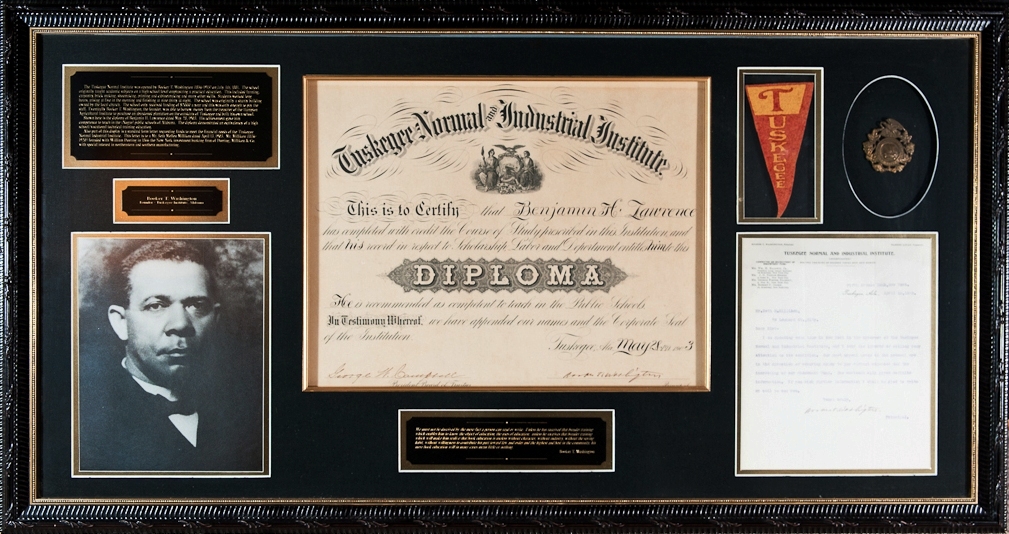
Booker T. Washington (1856-1915). Signed Diploma for a young graduate of Tuskegee Institute in 1903, including a signed letter and genuine Tuskegee memorabilia.
In 1881, Alabama State Senator W. F. Foster delivered on his promise to former slave, Lewis Adams, that if Adams would encourage African American voters to support his re-election, he would push forward a bill to establish Adam’s dream for a “Normal School for Colored Teachers.” Adams, along with school commissioner, George Campbell, a former slaveholder, hired Booker T. Washington to lead the venue. The 25-year-old professor from Virginia’s Hampton Normal and Agricultural Institute, taught students self-sufficiency in agriculture, carpentry, making and laying bricks, and raising buildings that the faculty designed, among many other marketable skills.
Relocating to Tuskegee, AL, students constructed all but the four original buildings and cultivated 2,300 acres of farmland. Because all were required to learn some form of labor, its name was changed to Tuskegee Normal and Industrial Institute. Despite its reliance on white-based state and private support, Washington insisted that Tuskegee have an all-black faculty, the first major educational institution in the South to do so. Today, as Tuskegee University, its more than 3,000 students earn undergraduate, masters, professional, and doctoral degrees in a wide variety of programs.
Booker T. Washington called for practical black progress through vocational skill, self-improvement, and entrepreneurship to eventually achieve economic parity. He and other Progressives envisioned an industrialized “New South” with an influx of northern investment.
Washington agonized about delivering his most difficult yet famous speech before a crowd at the Atlanta Cotton States International Exposition in 1895. Some excerpts:
“Ignorant and inexperienced, it is not strange that in the first years of our new life [as freedmen] we began at the top instead of the bottom; that a seat in Congress or the State Legislature was more sought than real estate or industrial skill. It is at the bottom of life we must begin and not the top.
[We have] without strikes and labor wars, tilled your fields, cleared your forests, built your railroads and cities, and brought forth treasures from the bowels of the earth [and] have proved our loyalty to you in the past, in nursing your children, watching by the sick beds of your mothers and fathers, and often following them with tear-dimmed eyes to their graves.In all things purely social we can be as separate as fingers, yet one as the hand in all things essential to mutual progress. The wisest among my race understand that the agitation of questions of social equality is the extremest folly, and that progress in the enjoyment of all the privileges that will come to us must be the result of severe and constant struggle, rather than of artificial forcing.
That all privileges of the law be ours, but it is vastly more important that we be prepared for the exercise of these privileges. [But] far above and beyond material benefits will be … a blotting out of sectional differences and racial animosities and suspicions, in a determination, even in the remotest corner, to administer absolute justice. This, then, coupled with our material prosperity, will bring into our beloved South a new heaven and a new earth.”
The address was soon dubbed the “Atlanta Compromise Speech,” as many dismissed its deeper meaning and took umbrage at Washington’s defense of segregation and his obsequious examples of slaves’ hard work and fidelity to masters they could otherwise have abandoned or harmed. Some said it meant he would go to any length to make peace with whites by not taking an aggressive stance on discrimination. Nonetheless, his speech bore fruit.
After his death, Washington’s educational influence was often eclipsed by W.E.B. Du Bois who advocated political and philosophical pragmatism as a forceful way to confront racism. Today’s scholars, however, are coming to appreciate that Julius Rosenwald’s private funding of nearly 5000 southern black schools overseen by Tuskegee beginning in 1913, later incorporated philanthropy consistent with Du Bois’ Talented Tenth concept by Rosenwald Fellowships for intellectually gifted students.