

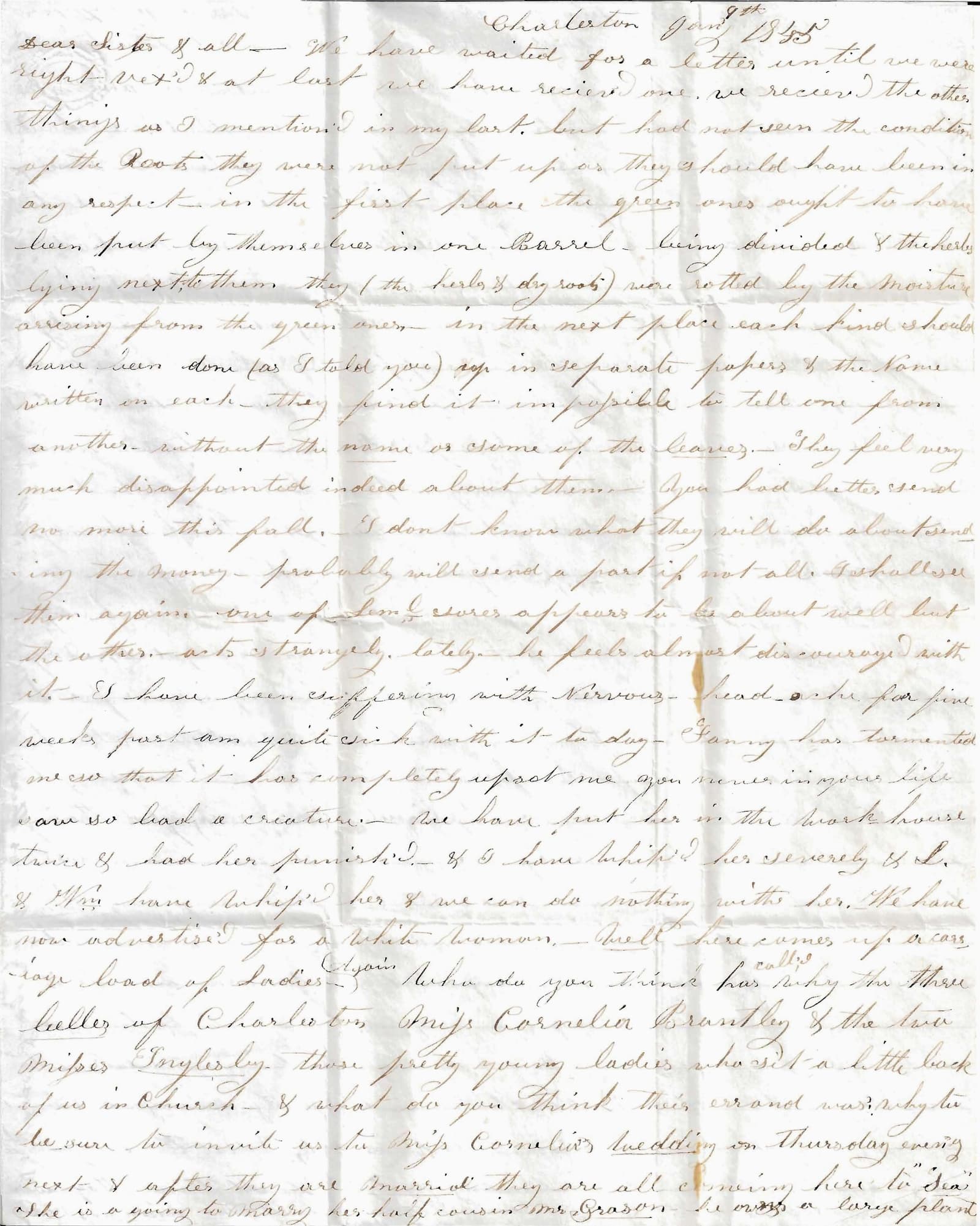
A House Servant is Whipped but Continues to Resist.
From the powerful hub of southern slavery, newlywed Emily Gay, age 19, and raised in Connecticut, writes her sister in Milford in 1845, concerning Charleston’s news, weddings, social events, and Fanny, her insubordinate slave. Charleston, SC, Jan. 9, 1845.
Depicted is page 1 of 4 with quoted passage.
“I have been suffering with Nervous head-ache for five weeks past – am quite sick with it today. Fanny has tormented me so that is has completely upset me. You never in your life saw so bad a creature. We have put her in the work house twice & had her punish’d & I have whip’d her severely & I & Wm. have whip’d her & we can do nothing with her. We have now advertised for a white woman.”
One may observe that Emily Gay, a well-educated newcomer to southern society, has readily conformed to the prevailing social order of gender, race, color, condition, and class, all of which precluded any identity of solidarity among women. But why were these women so at odds, and who, we ponder, was Fanny, and what might have caused her to rebel?
On plantations, slaveholders openly used their power of violence to conflict with traditional gender roles in forcing compliance. Few realize how insidious this indoctrination was to the mind and spirit of the witnesses, particularly women. Slaveowners often allowed men from other plantations to marry or breed, creating feelings of emasculation and divisiveness within the slave community. Kept in a perpetual state of fear and doubt, women responded by influencing their menfolk to maintain the safety and demeanor of pleasing their masters.
Such social conditioning and lack of education left slaves angry and resentful, but without well-defined concepts or the means of acquiring justice, freedom, or organizing resistance in following one’s own destiny. In Fanny’s case, sold-away and with no one else to protect, we surmise that once purchased by her new and inexperienced urban masters, Fanny exercised the only response to a system that made beasts out of both owner and their slaves.