

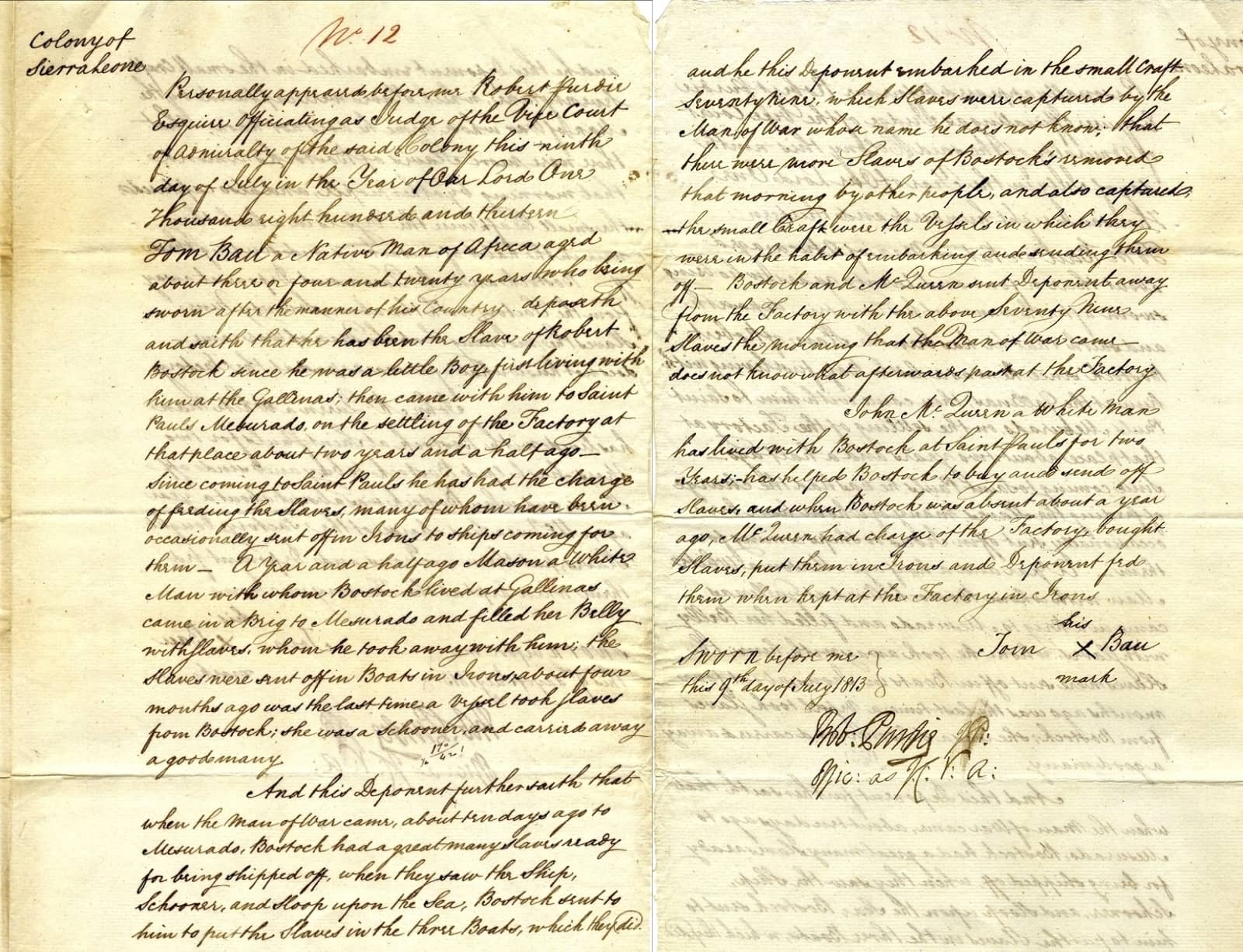
Liberated Slave Testifies to the British Court of Admiralty about His Employment at Bunce Island’s Notorious Slave Factory.
A two-page deposition of July, 9, 1813, signed by ex-African slave Tom Bau (approximate age 24), and colonial surgeon, Dr. Robert Purdie, substituting as judge. This remarkable document is an on-site eyewitness account of the Slave Trade as told by a recently freed African slave who had been present when the British Navy attacked, captured, and burned the infamous Bunce (also, Bance or Bense) Island slave factory on the St. Paul River above Cape Mesurado just twelve days earlier. The site is 20 miles upriver from Freetown, Africa’s only deep-water harbor.
In part, “Personally appeared before me, Robert Purdie officiating as Judge of the Vice Court of Admiralty of the said Colony … Tom Bau a Native Man of Africa … deposeth that he had been the Slave of Robert Bostock since he [Bostock, but both were children together] was a little boy … then came with him to Saint Pauls Mesurads on the settling of the Factory … Mason [an American captain] a White Man … came in a Brig to Mesrads and filled her Belly with Slaves … Bostock had a great many slaves ready for being shipped off, when they saw the Ship, Schooner, and Sloop upon the Sea, … and [Bau] embarked in the small Craft seventy nine, which Slaves were captured by the Man of War … John McQuren [McQueen] a White Man … at St. Pauls for two years, has helped Bostock to buy and send off Slaves, and … had charge of the Factory, bought Slaves, put them in Irons and Deponent fed them when kept at the Factory in Irons.”
The Bunce Island slave castle and factory was established in 1668 and successively used by four London-based firms until 1807. It is regarded as the primary source of captives from West Africa’s upper Guinea, “Rice Coast,” who were skilled in cultivating rice for Georgia and South Carolina. Rice-growing was profitable, but dangerously labor-intensive and required a complete transformation of coastal waterways for irrigation. Outlying areas, especially the many “Sea Islands,” enabled their Bunce embarked, Gullah-Geechee descendants to preserve much of their Guinean culinary, linguistic, religious, and cultural heritage.
Tens of thousands of these Lowcountry slaves had been supplied up to the American Revolution by Henry Laurens, rice planter, slave dealer, and Bunce Island’s business agent in Charleston, South Carolina. After taking a ten percent for each slave sold, he sent the balance to London, often in the form of rice. In 1777, Laurens was elected as President of the Continental Congress, America’s provisional government during the war, but as envoy to the Netherlands he was captured at-sea and imprisoned in the Tower of London. His release was arranged by Richard Oswald, the principal British owner of Bunce Island. The two had been business associates for thirty years, and once hostilities ended they negotiated the 1783 Treaty of Paris between their nations.
In 1792, leading British abolitionists founded Freetown to settle 1196 American slaves who had fled north with Loyalists to Nova Scotia, although 65 died on the way. In 1794, the French Navy attacked Freetown and destroyed Bunce Island’s fort. Incredibly, free Nova Scotians rebuilt the fort in the midst of slave trafficking until Parliament banned the trade in 1807. Ten months later, on January 1, 1808, Sierra Leone became a Crown Colony with Freetown as its capital and base for the Royal Navy’s West Africa Squadron tasked with enforcing the ban.
However, Bau’s deposition adds disturbing closure to what is known about Bunce Island. Over the next four years, Bunce’s castle and slave factory resumed operation to threaten the fledgling colony. Bunce’s new proprietors, Robert Bostock and John McQueen, incited local chieftains to terrorize Freetown’s settlers by kidnapping and selling anyone accused of stealing goods from their island. In June 1813, the renegade traders were captured during the naval landing cited above and delivered to Freetown where they awaited trial twelve days later.
This success, and the liberal prize-monies awarded the crews, motivated Sierra Leone’s governor to send the Navy up and down Africa’s West Coast and tributaries against non-colonial, hence illicit, factories and vessels. Though some claimed he exceeded his authority, several thousand captives were liberated and more than two hundred vessels were condemned and sold.
At present, Bunce Island is one of World Monuments Fund’s “100 Most Endangered Sites.” Because it was abandoned after the raid, much still remains, including: watch towers, slave quarters, residential blocks, storerooms, powder magazine, numerous cannons from different nations, its yard, water well, and tombstones, all lying unmolested, though many of the castle’s walls are collapsing and covered with tropical vegetation. Even the island’s beaches show evidence of the Middle Passage in being peppered with English flintstone used for ship’s ballast, jettisoned and replaced by the weight of the enslaved themselves.