

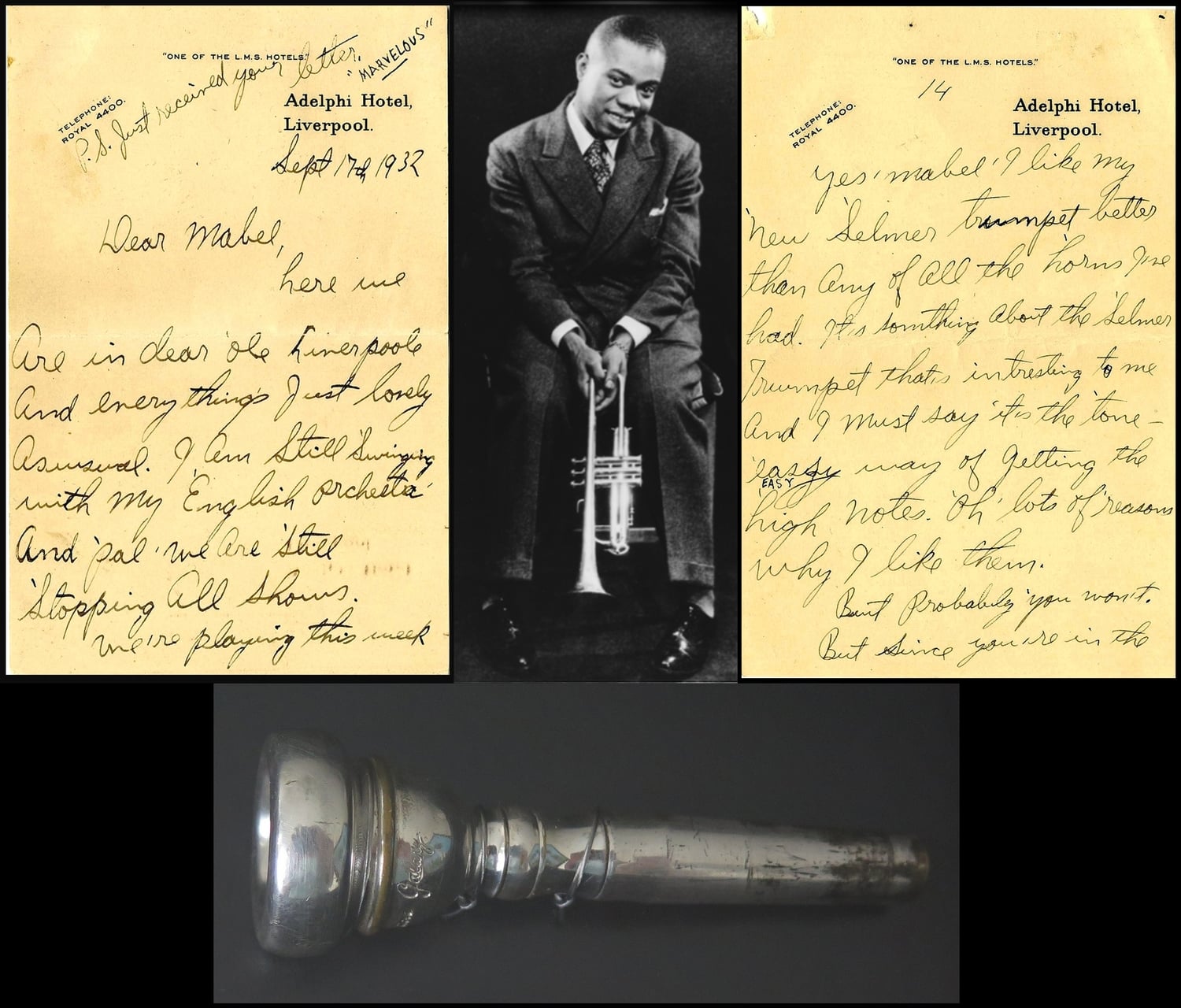
Louis Armstrong, perhaps the world’s best-known jazz impresario, writes a 19-page, signed letter from the Adelphi Hotel, Liverpool, England on September 17, 1932. In July, 1932, Louis Armstrong sailed to England for an extended tour. He spent most of the next several years in Europe, his American career bolstered by a series of archival recordings including the Top Ten hits, Sweethearts on Parade, and Body and Soul. His Top Ten version of Hobo, You Can’t Ride This Train, was on the charts upon his return to the States in 1933.
In this amazing letter, the great jazz trumpeter, vocalist, and orchestra leader writes to “Dear Mabel” (likely Mabel Wayne, a songwriter some of whose tunes Armstrong recorded as early as 1930) while on his tour of the British Isles. He describes his treatment and that of his orchestra, speaks of his third wife Alpha who is with him, critiques British musicians, and lauds his new Selmer trumpet. Some of the more interesting excerpts follow:
“It is some swell hotel believe me. I have about 4 or 5 more week’s bookings yet.–We’re now making a tour all through the Provinces and most of the (Big Towns). Theatres are named ‘Empire’ funny eh? And the people just crowds the stage doors waiting for me + Alpha to come out after the show and they’d touch us and wishes us good luck and would yell, “Three Cheers for Mr & Mrs Armstrong. And such yelling.– nice eh? So you wonder’d if I’d have trouble with my band over here – Naye [oh] – Naye [no] Salami [my child] no trouble atall no trouble atall. All the boys had to do was Swing as I told ‘em to do – and they did – and is still – yet. I explains to these musicians – in fact all musicians I work with – just what I want behind me. And it is honestly so simple until any musician that’s halfway up with the times will grasp understand? No pal – never no trouble. And you can take it from me – The musicians over here are just as hot or hotter than most musicians in America. They play all the latest music and knows all of the latest ‘Frases’ and they believe in their perfect tones. Yes Mabel, I like my new Selmer trumpet better than any of all the horns I’ve had. It’s something about the Selmer trumpet that’s interesting to me and I must say it’s the tone – easy way of getting the high notes. Oh, lots of reasons why I like them.”
Louis “Satchmo” Armstrong (1901-1971), one of jazz’s most innovative pioneers, was born into poverty in New Orleans. He began playing the coronet at the age of twelve while serving a term for delinquency at the Colored Waifs Home. Soon, his innate talent began to develop, and at the young age of eighteen he was playing with Kid Ory’s band in New Orleans, and also with Fate Marable on Mississippi River steamboats. In 1922, Armstrong joined the legendary King Oliver’s Creole Jazz Band in Chicago and, two years later, was hired by Fletcher Henderson and his trailblazing orchestra in which young Armstrong performed as a soloist with Bessie Smith and other leading blues artists. Armstrong shaped the course of jazz for the next two decades with his classic Hot Five, and Hot Seven recordings (1925-1929), establishing the role of the soloist in jazz. His first show business success occurred in 1930 with Ain’t Misbehavin,’ and he was featured in big bands in more commercial settings for the next seventeen years. In 1947, Armstrong formed his “All Stars,” a Dixieland-style sextet, with which he toured both nationally and internationally, the latter often under Department of State auspices. He also appeared in over fifty motion pictures. “America’s Goodwill Ambassador” died in 1971, and will always be remembered as one of the nation’s most beloved individuals and an inspiration to people of every race.
At center, is a well-used Brass Trumpet Mouthpiece belonging to and played by Louis Armstrong, who presented it to the late broadcasting legend Joe Franklin during a live radio interview from the Knickerbocker Hotel in New York’s Times Square.