1st Rhode Island Regiment – For over a year during the Revolution it had the Continental Army’s only segregated companies.
One of the bravest and longest serving Continental Army Line units of the Revolutionary War, the First Rhode Island Regiment as it evolved was known by many names, but most often as either “Varnum’s” or simply, “The Black Regiment.”
Failing to meet enlistment quotas at the beginning of 1778, Col. James Varnum, the unit’s commander, submitted an idea to Gen. George Washington to enlist slaves, an idea already vetoed by Southerners who claimed slaves would make poor soldiers and feared arming them. Washington, seizing the moment, confronted his own bias by forwarding Varnum’s letter to the governor, who in turn sent it to the R.I. State Assembly which voted in favor and enacted the plan on February 23rd, allowing “every able-bodied negro, mulatto, or Indian man slave … upon passing muster … [to] be absolutely free.” Recruits became freemen enlisting as privates under white officers for “three years or [duration of] the war,” with former owners compensated at market value.
By June 1778, the First was over 60% African and Native American with 197 blacks organized into four companies, some being segregated, and one of these was led by Capt. Thomas Cole. Replacing Varnum in overall command was Lt. Col. Christopher Greene, a relative of Gen. Nathanael Greene, Washington’s most trusted commander.
The First R.I.’s baptism of fire as a largely segregated unit came during the Battle of Rhode Island on Aug. 29, 1778. As the Continental Line retreated from Newport, RI, Col. Greene’s Black Regiment was deployed to hold part of a defensive line across the island that was collapsing rapidly. Opposing British and Hessian forces selected Greene’s position to make determined attacks, which three times were repulsed with much loss of life to the enemy. By saving the Army’s flank from a near disaster, over the next four hours, six Continental brigades withdrew to the mainland. Among those praising the Black Regiment was Major-General the Marquis de Lafayette, who proclaimed their performance “the best fought action of the war,” and chose from among them for his personal bodyguard.
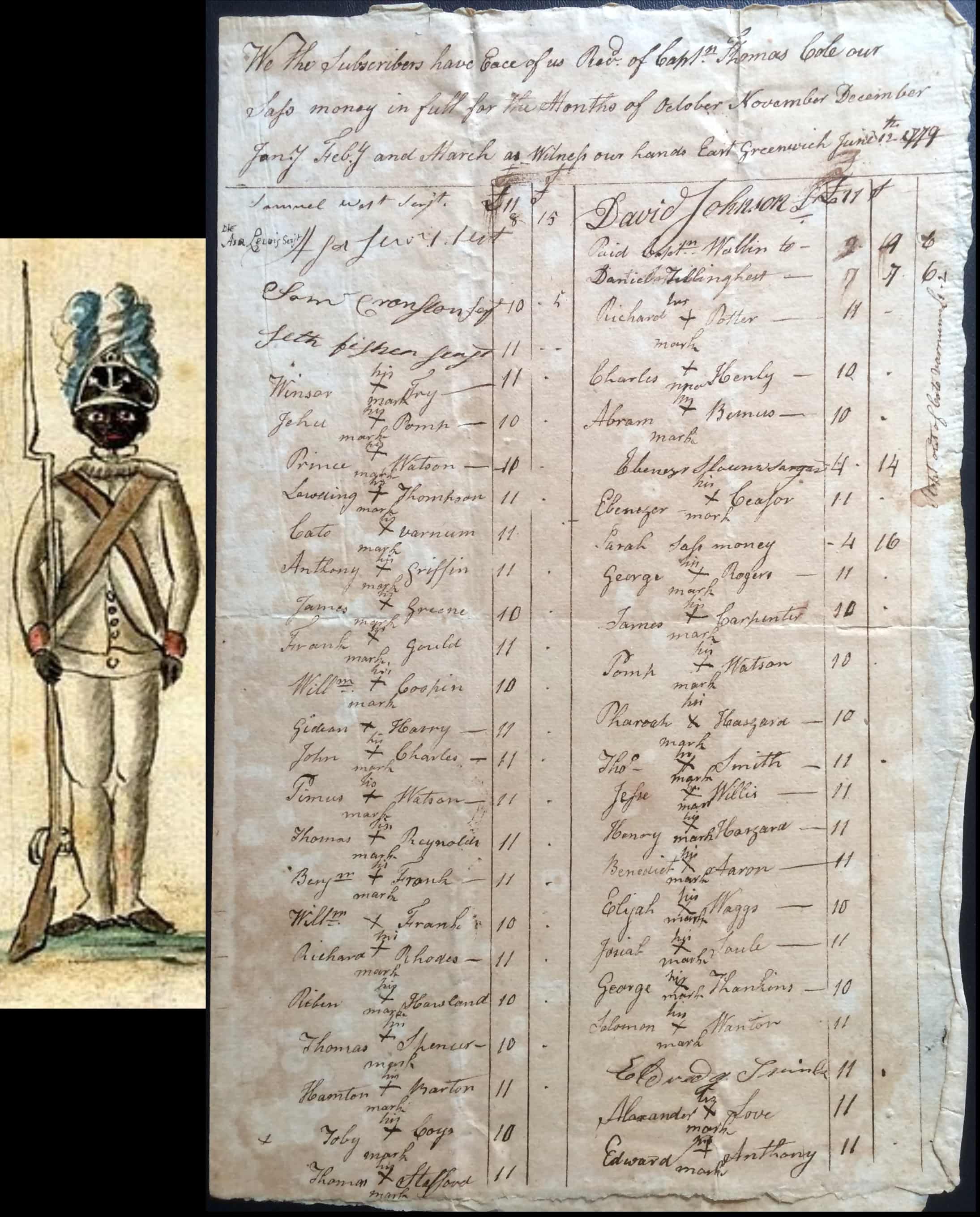
Above right, the company muster roll of 49 of Thomas Cole’s predominately black soldiers, who after the above action acknowledge receiving six-month’s pay (from October 1778 to March, 1779, some of it over a year late), in “sass money,” a term for Continental Bills, as there was no coin to be had. Ten were able to pen their signatures. Black soldiers marking with their “X” may be underrepresented since many waited until their enlistments ended to collect a lump sum to pursue lives as freemen. By now, although the unit was still considered segregated, whites began replacing blacks struck from service. East Greenwich, RI, June 12, 1779.
In January 1781, the First and Second R.I. were combined with another company to form the Rhode Island Regiment. Posted to patrol the Hudson River Valley’s hotly-contested “Neutral Zone,” on May 14, 1781, “De Lancey’s Cowboys,” a group of about 60 Loyalist insurgents, surprised the Black Regiment in their quarters. The African Americans reportedly “defended their beloved Col. Greene so well that it was only over their dead bodies that the enemy reached and murdered him.”
Lt. Col. Jeremiah Olney assumed command, whereupon the regiment rapidly moved south to join American and French forces marching through Philadelphia to the head of Elk River in Maryland, from where they went by water to Yorktown, Virginia for the war’s final battle (Sept. 29 to Oct. 19). The Black Regiment was placed near Lafayette’s on the American right where an observer noted it was “the most neatly dressed, the best under arms, and the most precise in its maneuvers.” During the night of October 14th, it notably took part in Alexander Hamilton’s famous assault and capture of Redoubt No. 10, the strongpoint on the extreme British left next to the York River. Cornered with no hope of escape, the prospect of facing American cannonades at point-blank range forced Cornwallis to capitulate after eight years of war.
The next morning, Georg Daniel Flohr, a French private in the Royal-Deux-Ponts, inspected the damage inflicted upon Redoubt 9, where he’d participated, and 10. Later writing in his 250-page memoir, Flohr was horrified: “Everywhere dead bodies lay around unburied, the majority of them blacks.”
French Sous-lieutenant Jean-Baptiste-Antoine DeVerger, who also participated in the battle, afterwards made a watercolor sketch of four soldiers from various units titled, “American soldiers at the siege of Yorktown, 1781,” (Brown University Archives). Above left, standing at attention is the one he depicted from the then-famous Black Regiment.
In Lafayette’s engraved portrait later presented to George Washington, entitled, “Conclusion de la Campagne de 1781 de Virginie” (at Library of Congress), there is seen a black man thought to be James Armistead (1748-1830), Lafayette’s bold double agent, holding the reins of the General’s horse. Armistead was invaluable in ending the war by gathering vital information prompting Washington to move the bulk of his army southward, leading directly to Lord Cornwallis’ defeat. However, the portrait’s very youthful soldier wears a bushy, two-toned feather plume and an unusually white military jacket with dark wrist-cuffs – all appurtenances of the Rhode Island Regiment’s handful of men tasked as Lafayette’s bodyguard.