

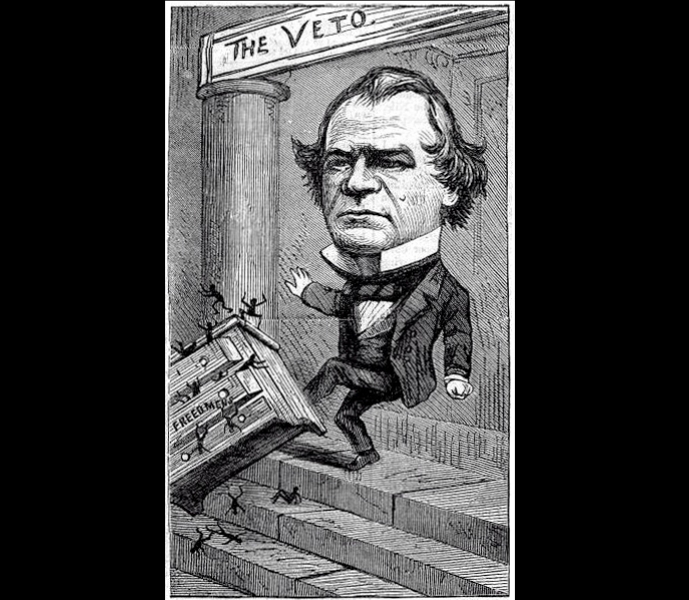
Lincoln’s Obstructionist Successor, Andrew Johnson.
Lincoln’s vice president, Andrew Johnson, was a Tennessee Democrat chosen to replace the capable Hannibal Hamlin for the 1864 election so that Southerners would vote Republican. Hardly any did. Johnson had risen from poverty and identified with poor white Southerners. He resented the slaveowning class, but after the war’s conclusion was more concerned in protecting such grandees from what they saw as a new threat. “White men alone,” Johnson told one senator, “must manage the South.”
Johnson was soon considered ill-suited to be president and vetoed nearly every congressional bill advancing civil rights except the 13th Amendment which outlawed slavery, whereby he declared Reconstruction of the South complete. When Congress repeatedly “passed measures over the President’s veto it was without debate. There was no longer the need for discussion,” wrote Johnson’s bodyguard, William Crook.
The President’s lenience included political amnesty, restoration of land, approval of regional governments able to enact “Black Codes” that resurrected slavery in all but name, as well as firing Secretary of War Edwin Stanton for opposing such tactics. With this, an outraged House of Representatives impeached Johnson on February 24, 1868, but the measure to convict him in the Senate failed by a single vote.
Above is a lampoon of President Johnson wrecking the Freedmen’s “Bureau” by vetoing the renewal of its congressional charter. Despite its concerted efforts this organ-advocate for the ex-slaves was allowed to “die on the vine.” Harper’s Weekly, April 14, 1866.