Plantation Ledger Recalls Virginia’s Tidewater Aristocracy that Codified “America’s Original Sin.”
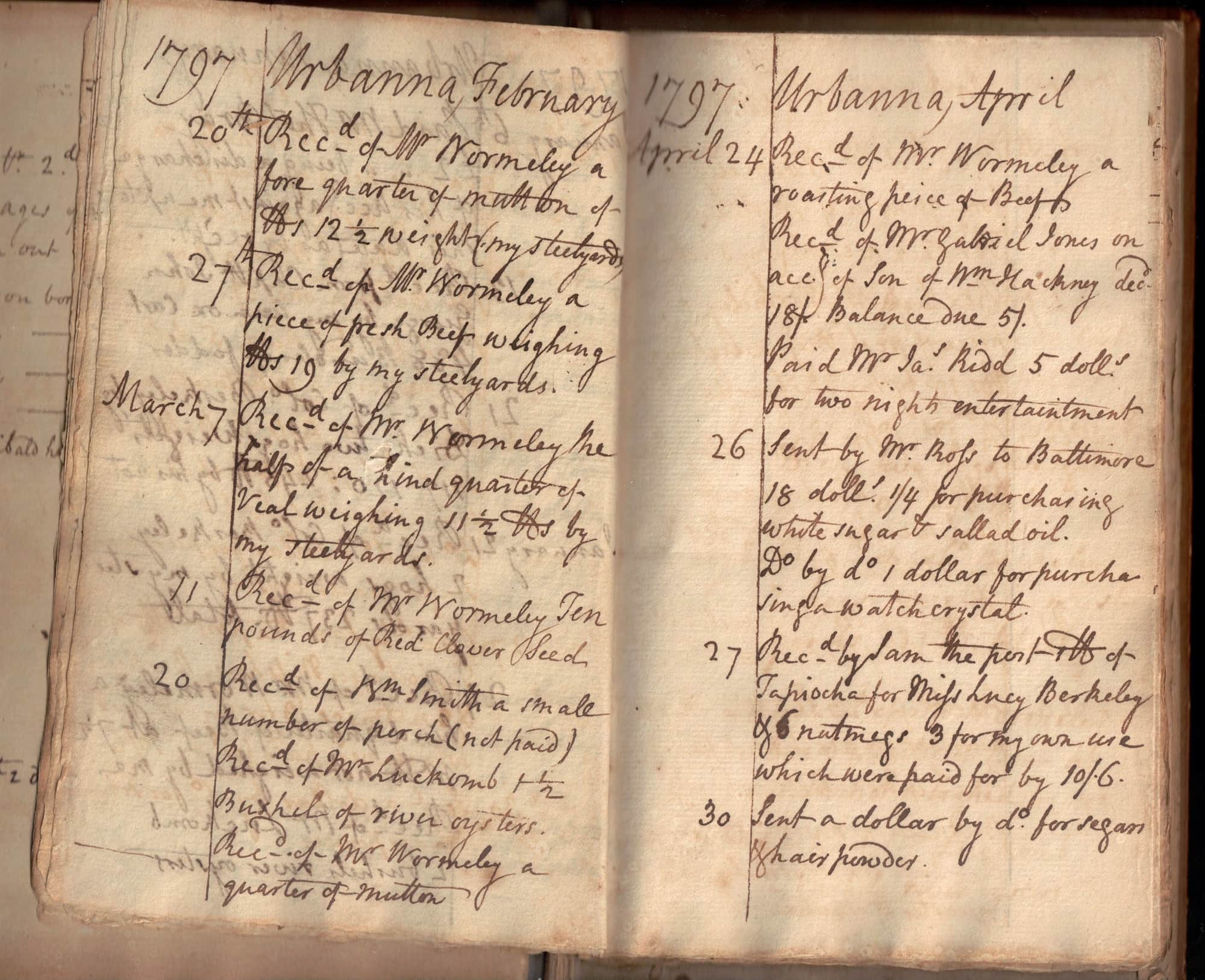
The James Ross River Plantation is sited on the Chesapeake Bay, ten miles up the Rappahannock River at Robinson Creek in Urbanna, VA. This exceedingly rare ledger book spans the short period from October 19, 1795 to April 30, 1797, when an unnamed overseer recorded receipts and expenditures for the estate of James Ross, the plantation’s late founder. His many entries include a weekly supply of meat, fish, or fowl, and ascertaining the ages of slaves purchased from another estate. His accounting infers a profitable enterprise, and that Ross’s only son is assuming an active role. The overseer refers to dealing with over thirty townspeople, some very prominent, but chiefly with his aristocratic neighbor, Ralph Wormeley V (1744-1806), the fifth and final descendant of Urbanna’s founder.
Prior to his beheading in January 1649, England’s King Charles I granted land to Christopher Wormeley, which that same year was willed to a half-brother, Captain Ralph Wormeley, Esquire. The Urbanna tract was among the largest colonial patents of Middlesex County on Virginia’s Middle Peninsula. Captain Ralph initially brought along five indentured servants to cultivate a new and pleasurably addictive native crop called tobacco. Before his own untimely death in 1651, he listed an indeterminate number of “negroes” in his will. In that short time, however, tobacco and a growing number of African slaves had enabled Wormley to double his beloved Rosegill plantation to 3,200 acres.
By 1675, nearly the rest of Virginia had been given to Royalist supporters by Charles II, then exiled in France. Thousands across Virginia were free of indenture, but landless and unrepresented. Some 500 whites, free blacks, and slaves united under young reformer, Nathaniel Bacon. Rising first against the Powhatan Indian Nation, they ultimately defied Governor Berkeley’s weak, autocratic and corrupt government. Jamestown, the capital city, was burned, as were many tobacco plantations and crops.
But to some, unifying blacks with whites was problematic, and over time blacks were transitioned from servants and into slaves. By the time Bacon’s Rebellion failed in 1676, laws had been passed to prohibit miscegenation and to keep servants segregated by race. White males gained tax breaks and privileged status, whereas blacks and black women’s “increase” (children) were made “chattels” (movable or transferable property) with their legal status following the race of the mother.
During the rebellion, Sir Henry Chicheley (who married Capt. Wormeley’s widow, Agatha in 1652) had been a Burgess, or local representative. He heard the rebels’ complaints and tried to broker a truce, but labelled a traitor, was held hostage by them until the insurgency collapsed. Likewise, his pleas to diversify agriculture and disdain for consuming tobacco fell on deaf ears, including the King’s. Being childless, his stepson Ralph Wormeley II, inherited in 1683 a realm free from dissent in being a color-based rather than a class-bred society. Replacing white indentures with African slaves yielded a continuous supply of cheap labor. Immense wealth and high political office followed for dynasties of Wormeleys and their elite, Tidewater “First Families of Virginia” neighbors: the Edmund Berkeleys, Lewis Burwells, Robert Carters, Philip Grymeses, and Christopher Robinsons.
In 1640, John Punch, a black, and two whites were together sentenced for fleeing their indenture at Hugh Gwyn’s, a former judge and nearby member of the House of Burgesses. The European men each received four extra years of servitude while Punch was enslaved “for the time of his natural Life.” In 1705, to clarify its evolving statutes, the Virginia General Assembly enacted Slave Codes, one of which used that precedent to enslave blacks for life. Adopted by other colonies, such statutes were the genesis of perpetual, racially based slavery – better known as Chattel Slavery, or “America’s original sin.”
With the quality of colonial tobacco in question, the Virginia House of Burgesses passed an act in 1680 against shipping it directly from private wharves. Wormeley II, apportioned 50 acres of Rosegill and paid 10,000 pounds of tobacco to comply with the act’s provision to establish one of twenty official ports. Named to honor Queen Anne in 1706, Urbanna was a magnet for merchantmen with local warehouses to inspect, store, and trade the crop. It was soon the county seat, and its tobacco inspectors were paid comfortable salaries to sample and grade each batch to discourage fraud. Fines for exporting inferior product were severe and included prison.
Once dried and cured, tobacco leaves were compressed by winch into large wooden casks, called hogsheads for shipping. Today, folks in Urbanna and nearby Fairfax, as well in Maryland, Delaware, and North Carolina, drive their local “Rolling Road,” not realizing that slaves manhandled bulky hogsheads along these byways to rivers or seaports. It was an era when what we now term white supremacy and privilege was more than land, wealth, or heredity, it was the law.
Notable ledger entries, all from 1796, include:
“February 19, Rec’d of Overton Fosby, Esqr, by the hands of Mr. Peter Kemp the sum of 650 pounds Curr. money which was lodged in Mr. Ross’ Iron chest.” (Note, Fosby was a “factor” or business agent for the Kemp Tobacco Warehouse downriver; and Peter was a descendant of Richard Kempe, an acting governor who assumed colonial leadership after the Third Anglo-Powhatan War, 1644–46.)
“Dec. 3, Rec’d from the Store 215 French Crowns which were paid to Col. Roane as Administ. to the Estate of Col. George Daniel dec’d. in part payment of my Bond for 115 pounds with Interest up to this date, which Bond was given for the purchase of a Negro woman Katy & Children, a Bed, lot of Hogs &c.”
“Dec. 5, Paid Captn. Mathew Anderson 2 pounds 5. 9 for expenses which he was at freighting down to Norfolk & shipping two hogsheads of Tobacco belonging to me at Poropotank Warehouse, as by his recp’t (via the vessel Peter to Airken Birkett & co.)”
“Dec. 20th. Rec’d of Col. Edmund Berkeley 4 hogs. Weights by my steelyards 120, 120, 120, 116. According to his Note by his steelyards they weigh 130, 130, 120, 120. 500 wt. Total. By my steelyards 476 wght.” (Note, Edmund was the great-great nephew of Sir William Berkeley, the longest serving governor of VA, 1642-52 and 1660-77, i.e., during Bacon’s Rebellion, 1675-76.)
“Dec. 28, Lent to Mr. Wormeley (by the hands of Master Ralph), 30 dollars for Aikens Letters & Paines Works & returned him Hume’s Essays & Jeffersons Correspondence.”
“Dec. 28, Balance now at the Store in Bag No. 1. 933 1/3 dollars, No. 2. 400 Dollars, No. 3. 405 Crowns 1.10 1/2.”
An inside page lists five slaves and their birth dates, including a now 26-year-old Katy (or Caty) with Archibald, presumably the first of her “Children,” cited on Dec. 3, above:
“Sept. 2d. Procured of Col. Thomas Roane the ages of the following Negroes who took them out of Col. George Daniel’s note book.
Nelson born August 1st, 1764
Ned June 20th, 1771
Billy Sept. 23d. 1773
Caty Dec. 12th, 1769
Archibald her son October 8th, 1788”
Rosegill eventually became the residence of two colonial governors, but today, has been repurposed for weekly rental, and the James Ross River Plantation for weddings and receptions, both reimagining the gentility, hospitality, romance, and mystery of the South. Like the overseer’s ledger, these picturesque sites avoid mention of chattel slavery and its dehumanizing characteristics.