Orders from “Wild’s African Brigade” Headquarters During the Lengthy Siege of Fort Wagner.
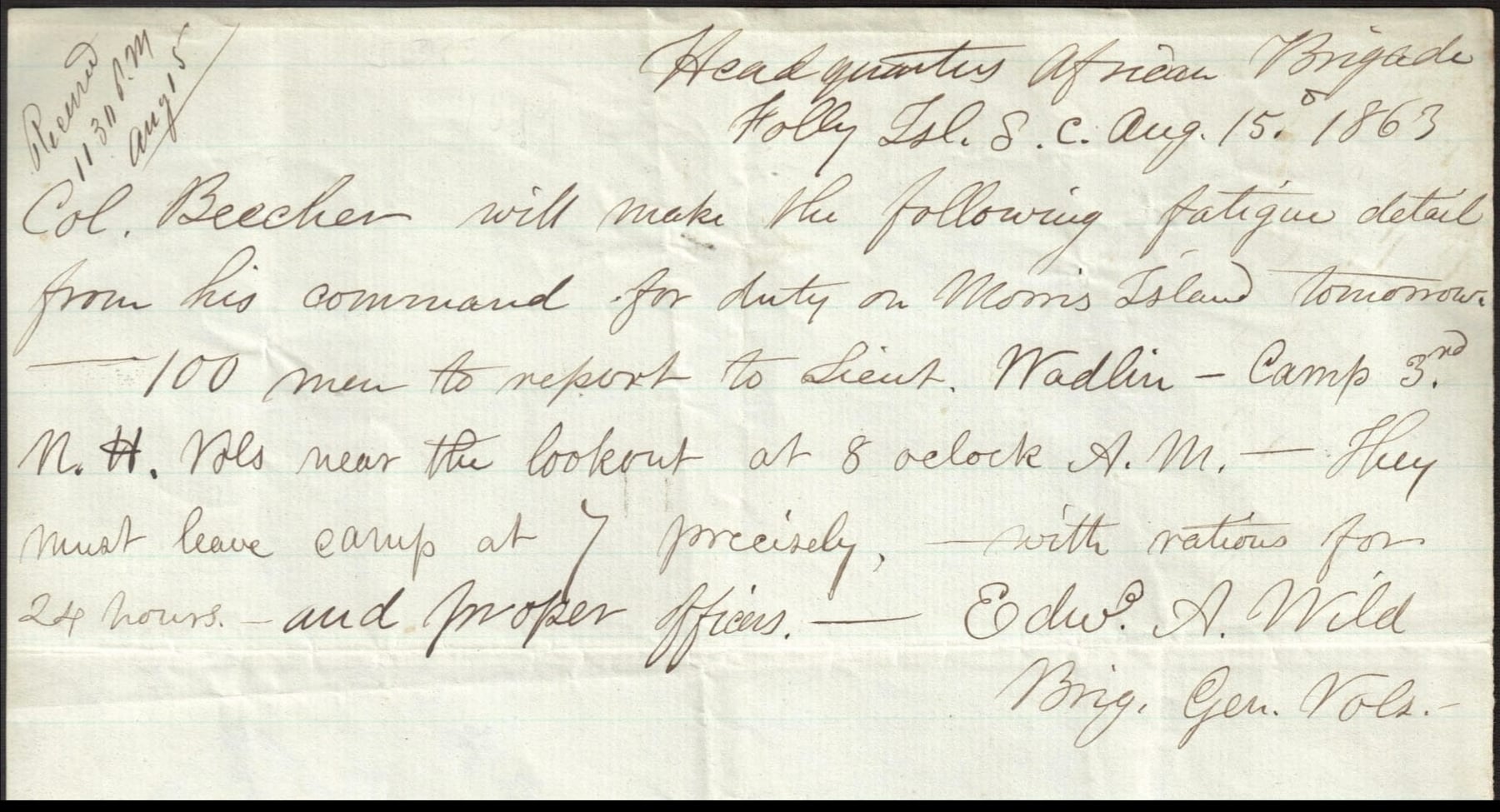
Brig. General Edward Augustus Wild (1825-1891), Commander of the African Brigade stationed on Folly Island in Charleston Harbor, SC, on August 15, 1863, sends a work detail of 100 black soldiers to Morris Island where the 58-day siege of Fort Wagner continued. The order was given nearly a month after the epic but suicidal assault by the 54th Massachusetts on Ft. Wagner, shown in the previous item.
The order reads in full:
“Received 1130 P.M Aug 15
Headquarters African Brigade
Folly Isl. S.C. Aug. 15th 1863
Col. Beecher will make the following fatigue detail from his command for duty on Morris Island tomorrow.
—100 men to report to Lieut. Wadlin – Camp 3rd N.H. Vols near the lookout at 8 oclock A.M. — They
must leave camp at 7 precisely, — with rations for 24 hours. – and proper officers.
— Edw’d. A. Wild
Brig. Gen. Vols.”
After raising a company of white volunteers, Colonel Wild lost an arm leading them in battle. A devout abolitionist, he returned to Massachusetts to recruit African American volunteers into the 55th Infantry Regiment. Massachusetts’ Governor John A. Andrew had been instrumental in creating the 54th and 55th, and may have had Wild in mind when suggesting to Secretary of War Edwin M. Stanton the idea sending “some able, brave, tried, and believing man as a brigadier” to recruit former slaves in North Carolina as a model for future black regiments in the South.
Promoted to brigadier-general, in June 1863, Wild resumed duty in New Bern, NC, to combine the 55th with ex-slaves to be recruited into the 1st North Carolina Colored Volunteers (NCCV). Wild was given authority to select the brigade’s fifty-three officers and he chose northern abolitionists. These included Lt. Col. James C. Beecher, a missionary to China and half-brother to author Harriet Beecher Stowe to command the regiment, and William N. Reed, a Mulatto, as lieutenant colonel in the 1st NCCV, the highest ranking African American officer of the war.
Colonel Beecher was placed in charge of recruitment, and with the help of prominent Boston abolitionist Edward W. Kinsley, and Abraham H. Galloway, a local Mulatto and Union spy, they enlisted 980 men in just 30 days. They had come from over forty counties and many other states, and the 1st NCCV was officially mustered into service June 30, 1863. By the time the above order was given, “Wild’s African Brigade,” as it was now called, included a small detached part of the 2nd NCCV, and would soon include the 3rd NCCV. A later 4th NCCV was a heavy artillery unit, and altogether, 5035 black recruits were raised in these regiments.
The following passage is excerpted from “Fifty-Fifth Massachusetts Infantry Regiment (African Descent) Regimental History,” 1995, by Bennie J. McRae, Jr., which indicates that the 100 men chosen for the above fatigue detail were drawn from the 55th Massachusetts (Colored) Volunteers, the “sister” regiment of the famous 54th Massachusetts that led the legendary, but ill-fated assault on July 18, 1863:
“After training at Readville, MA, the 55th regiment broke camp on July 21, 1863, proceeded to Boston, arrived at Morehead City, NC, and debarked from the transport “Cahawba” on July 25th. On August 2nd, the regiment embarked for Folly Island, below Charleston, SC, and was assigned to Wild’s African Brigade, Vogdes’ Division, 10th Corps, Dept. of the South. During August and September they built entrenchments and performed fatigue duty, constantly under fire from Forts Wagner and Gregg just to their north on Morris Island.”
Fatigue duty means labor performed without weapons, such as draining swamps or building fortifications, and it was often given as punishment. Wild’s brigade confronted racism and prejudice, and its officers formally complained of their subservience in laboring and setting up camp for white regiments, especially after the heroism blacks had shown at the Louisiana battles of Port Hudson in May 1863, and Milliken’s Bend that June – further demonstrated barely a month before the above orders by the 54th Mass. at their very location.
“Some commanders,” wrote the President that August, “who have given us our most important successes … believe that the emancipation policy and the use of colored troops constitute the heaviest blow yet dealt to the rebellion.” Still, those heralded units had been sourced in free black communities, and even abolitionists wondered whether ex-slaves could be relied upon after the dehumanizing effects of slavery.
After toiling on the sweltering beaches of Charleston Harbor, the 2nd and 3rd NCCV made forays into southeastern Virginia, and during the winter of 1863, brought the heavy hand of war to several coastal counties in North Carolina. Wild’s African Brigade was labelled “a terror” by Confederate newspapers and officials in destroying rebel camps and railways, freeing over 2500 slaves, harrying irregulars, and hanging Daniel Bright, one of the region’s most notorious guerrillas.
The Army broke up Wild’s African Brigade in December 1863 when the 2nd and 3rd NCCV regiments were transferred to Fortress Monroe in Hampton, Virginia, under Maj. Gen. Benjamin Butler. On February 14, 1864, the untested 1st NCCV regiment boarded transports to Florida to disrupt rail service for the CSA’s new breadbasket. Still, questions remained as to the ex-slaves’ capacity and willingness to fight a protracted battle against Confederate regulars. Those doubts would be countered six days later during the Battle of Olustee.
Meanwhile, in recognizing the African Brigade’s achievements, in January 1864, the Union awarded General Wild with overall command of the Department of Norfolk, in Virginia, where he successfully directed black troops in the XVIII Corps at the Battle of Wilson’s Wharf and during the Petersburg Campaign. Upon the Confederate evacuation, Wild’s black troops marched triumphantly into Richmond and were part of the city’s occupation force.
As a measure of gratitude to his African American troops, Wild later oversaw the Freedmen’s Bureau in Georgia.