

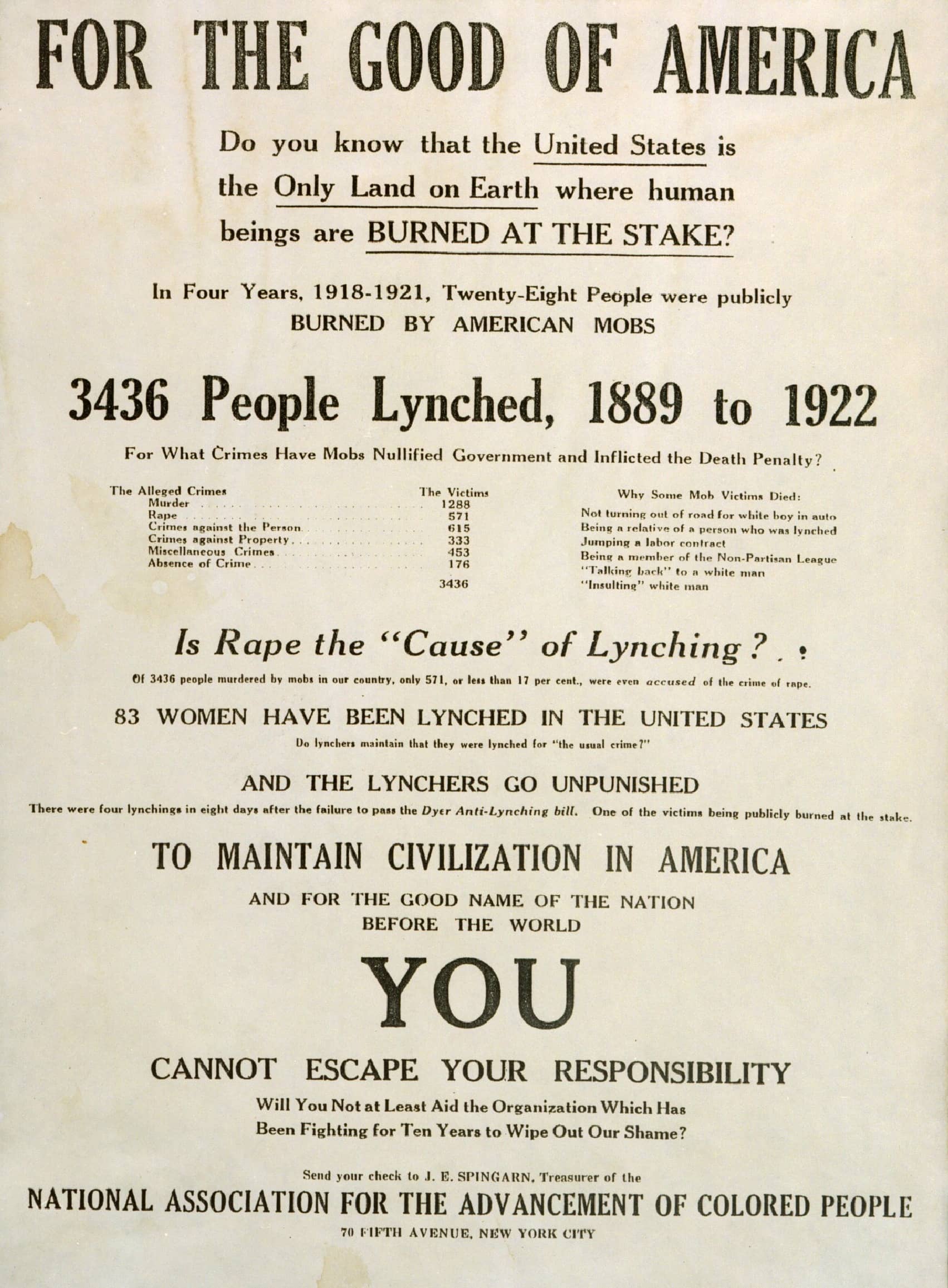
1922 NAACP Anti-Lynching Poster. From a fundraising campaign to pass legislation in order to make the act of lynching illegal – it was not yet on the books as a crime!
From 1920 to 1938, whenever the the NAACP received such news, it hoisted a large black flag above its New York offices with the words, “A MAN WAS LYNCHED YESTERDAY.”
Of course, it wasn’t just men who suffered. Any perception of disrespect towards whites, however trivial, could result in a lynching. One never knew; the happenstance of inquiring about a raise in salary, serving in the military, or just walking behind a white woman would qualify.
Although Virginia had the lowest number of lynchings in the South, the savagery of mob violence, particularly against blacks, had risen alarmingly due to a resurgent KKK. Among the atrocities in rural Virginia:
In 1925, a Sussex County mob hung black man from a tree near the railroad depot, riddling his body with bullets and setting it afire in plain view of an arriving passenger train.
In Wytheville, the following year, a mob stormed the county jail and shot Raymond Bird, 31, accused of assaulting the two white daughters of his employer. While local officials knew a mob had formed, they did nothing to protect their prisoner. The mob then beat Bird’s head “into a pulp,” tied a rope around his neck, attached it to a waiting auto, and dragged him nine miles, before hanging his body from a tree and filling it with bullets.
In 1928, Virginia’s recalcitrant governor, Harry Flood Byrd, Jr., was finally persuaded to define lynching as a state offense and asked the state legislature to draft a bill prohibiting it, becoming the only state to ever do so.
Louis Isaac Jaffe, a white man, and editor of the Norfolk Virginia-Pilot, was awarded the Pulitzer Prize in 1929, for his scathing editorials and brave reporting of the gruesome facts in forcing Governor Byrd and Virginia’s General Assembly to act. Though no whites were ever convicted of lynching blacks under the law, some were brought to justice for attacking other whites.
Between 1882 to 1968, nearly 200 anti-lynching bills were introduced in Congress, and between 1890 and 1952, seven U.S. presidents petitioned Congress for a federal law, yet only three were passed in the House of Representatives. Due to opposition by the Southern Democratic voting bloc, none of these were approved by the Senate. Not until 2005 did the Senate formally apologize for its failure to enact anti-lynching bills “when action was most needed.” Finally on December 19, 2018, the Senate unanimously voted to make lynching a federal crime punishable by life in prison.
The Equal Justice Initiative has determined there have been nearly 6,500 lynchings and racially suspicious murders committed in the U.S. prior to 1950, with few attempts to prosecute. Ongoing research indicates the figure may be higher. In December 2016, outgoing President Obama renewed a 2008 bill, the Emmett Till Unsolved Civil Rights Crimes Act, which allows the FBI to investigate cold cases throughout the Jim Crow era and up to 1980.