

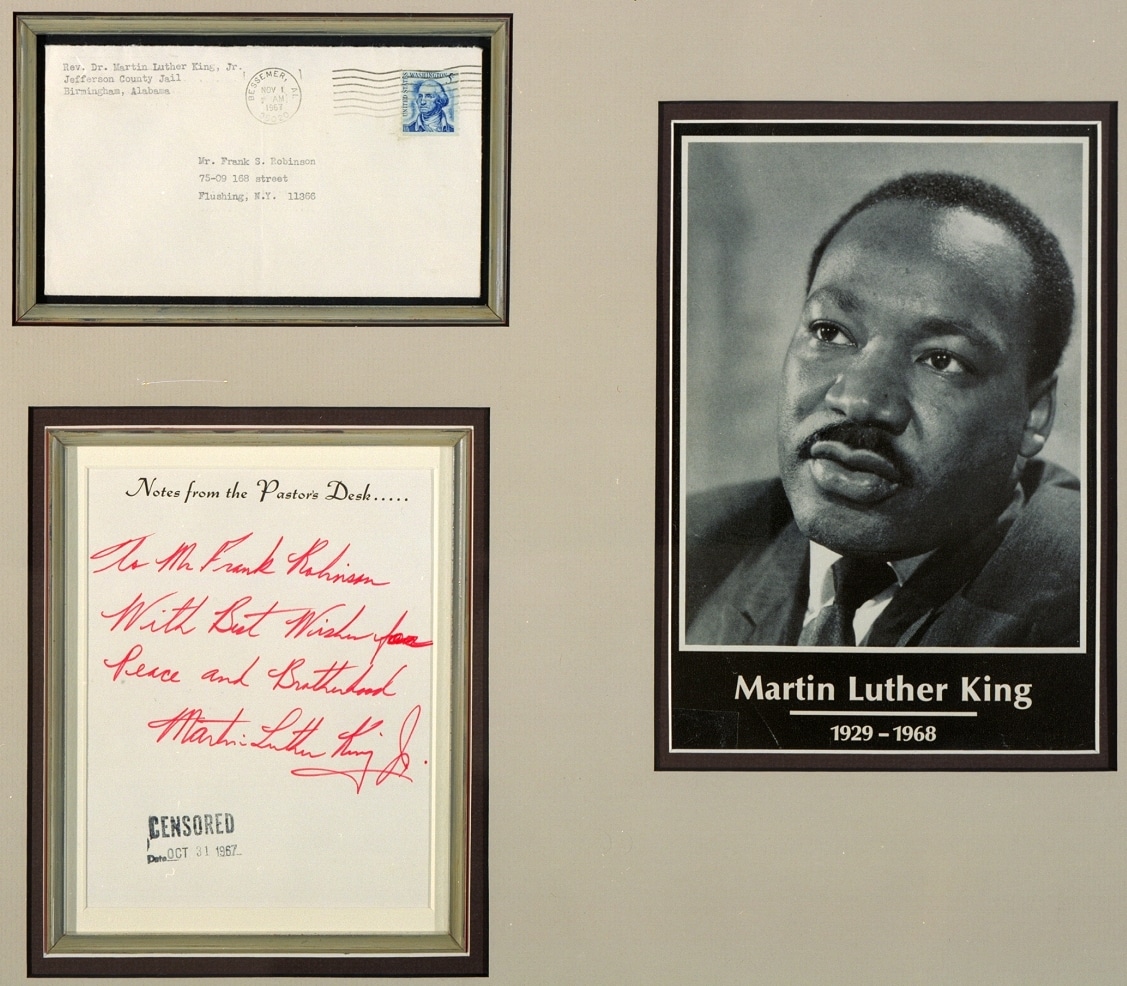
Dr. Martin Luther King, Jr., sends “Censored” note from a Birmingham Jail, in 1967.
The career of Reverend Martin Luther King, Jr. made a dramatic turn toward the Civil Rights Movement in December 1955, when asked to lead the Montgomery Bus Boycott following the arrest of Rosa Parks. Prior to this, King’s avowed mission concerned the unemployment, economic inequality, and slum conditions that African Americans were obligated to endure. Remembered as a martyr to Civil Rights, Dr. King never abandoned his commitment to economic justice.
Life was especially hard for blacks in Birmingham, Alabama. Everything was racially segregated, from businesses to libraries to churches, and they faced constant threats of violence. After a three-months-long boycott against the city’s white-owned-and-operated businesses failed to produce results, King and seven other Civil Rights leaders were arrested on April 12, 1963, for demonstrating against these conditions without a permit, although they had applied for one. It was King’s thirteenth arrest.
They were sentenced to five days for disobeying a temporary restraining order by leading a protest march on Good Friday. While in jail, King responded to criticism from white clergymen by writing his seminal 7,000 word response, “Letter from Birmingham Jail,” on April 16, defending the nonviolent protest and explaining why he had broken the law: “I am here because injustice is here … I would agree with Saint Augustine that ‘an unjust law is no law at all,'” and with Chief Justice Earl Warren that “justice too long delayed is justice denied.” Truly, Dr. King’s message and example energized the nation to begin the process of desegregation across the land.
However, it wasn’t until October 30, 1967, that the Supreme Court in a 5-4 decision, upheld the 1963 convictions in returning them to jail to serve out their sentences. Fanfare surrounding King’s expected arrival in downtown Birmingham prompted officials to reroute him along with his brother, A.D. King, and Reverends Wyatt Tee Walker and Ralph Abernathy, to the Bessemer Jail, 14 miles away to escape public and media attention. After serving four days of his sentence, authorities released King a day early in order to avoid a mass rally planned to celebrate his release. Upon his release on the 4th of November, he would have only five months left to live.
Above, soon after his re-arrest and incarceration on October 30, Dr. King pens a note to a young law student that is stamped “Censored” and released the following day, October 31, 1967. The envelope’s return address, recalling the famous 1963 event and letter, was likely typed in advance, “Jefferson County Jail, Birmingham, Alabama.”
Dr. King would come to be imprisoned 29 times, mostly for acts of civil disobedience, but at times for loitering and trumped-up, petty traffic violations.