

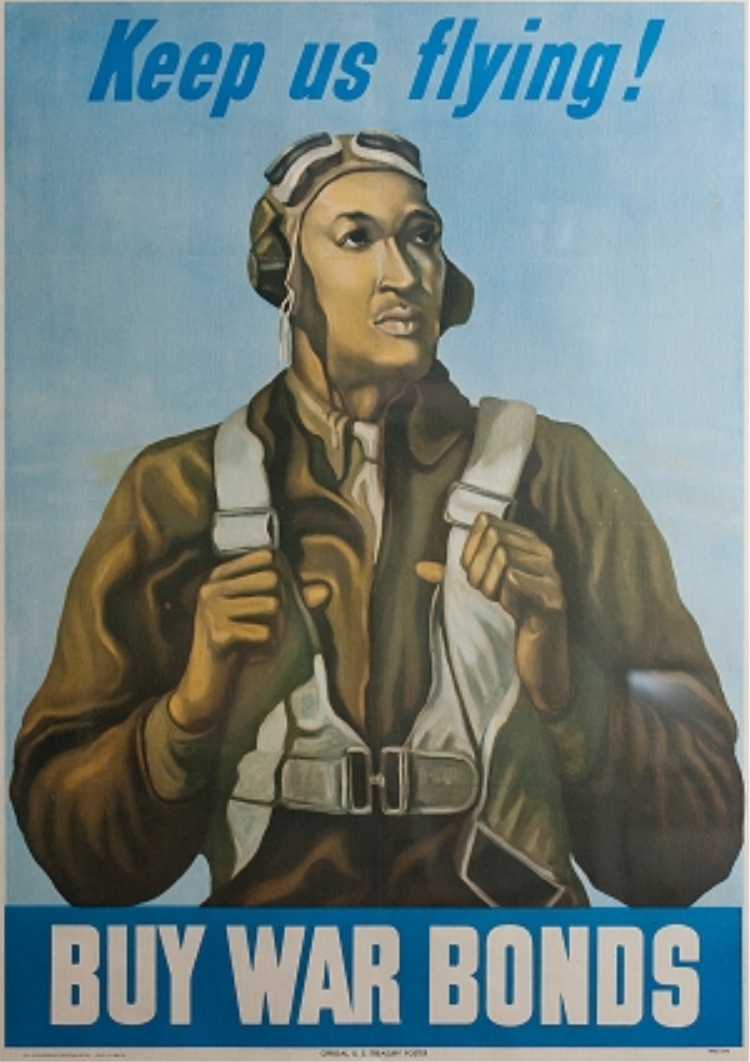
Large graphic broadside depicts Lt. Robert W. Diez, one of the famed World War II “Tuskegee Airmen” in full flight gear, appealing for contributions to the war effort.
The Tuskegee Airmen were African American cadets who trained at Tuskegee Institute’s Moton Field, and then took advanced training at the Army Air Corps’ Maxwell Air Base, also in Alabama.
In the mid-1930s, a Tuskegee alumnus, the noted black Illinois National Guard pilot and soon to be commander of the Ethiopian Air Force, John C. Robinson (1903-1954), urged the Institute to open a school of aviation as soon as funding was available. At long last, a contract from Air Command ordered flight training to commence July 19, 1941, just six months before Pearl Harbor. On March 7, 1942, the school’s first five graduates included Cadet Benjamin O. Davis, Jr., whose father had become the first African American U.S. Army general in 1940.
During WWII, the Airmen deployed to North Africa and then Italy to support the Army’s beach landing at Anzio, where eight fighter squadrons together claimed 32 German aircraft shot down, while the 99th alone manned obsolete and war-weary planes to claim 13 of them, thus proving its worth to unbelievers who wanted the units disbanded. Finally issued first-rate planes, the squadrons provided cover for long range bombers attacking Axis oil refineries, aircraft factories, and railway marshaling yards. During one mission over Berlin on March 24, 1945, three pilots: Lieutenants Earl Lane, Charles Brantley, and Roscoe Brown, flying piston-engined P-51 Mustangs, each shot down an ME-262 jet fighter. Though not publicized at the time, their feat earned the 332nd Group a Distinguished Unit Citation.
Often outnumbered in the air, pilots of the 99th, 100th, 301st, and 302nd Squadrons of the 332nd Pursuit Group were credited with destroying more than 260 enemy planes. Of the 992 men trained, 335 deployed overseas, 68 were killed either in action or in accidents, 12 on non-combat sorties or during training, with 26 still listed as MIA. 32 ended up as POWs. Over 16,000 served as ground personnel.
Overall, the “Red Tails,” or “Red Tail Angels,” as appreciative bomber crews named them for the color of their rudders, were awarded three Distinguished Unit Citations by compiling an unmatched record for heavy-bomber escort, losing only 27 bombers as compared to an average of 46 among the six other 15th Air Force fighter groups then stationed in Italy. The 99th Squadron is still lauded for never losing a bomber it escorted to and from its target.
Some of Tuskegee’s pilots and crews were later trained to fly B-25 bombers, but the war ended before the 477th Bombardment Group’s squadrons could be sent overseas. Nonetheless, in April 1945, 120 of its officers were arrested for non-violently integrating a whites-only officers’ club at an Army airbase in Indiana. The so-called “Freeman Field Mutiny” became a landmark case for the coming Civil Rights movement.