

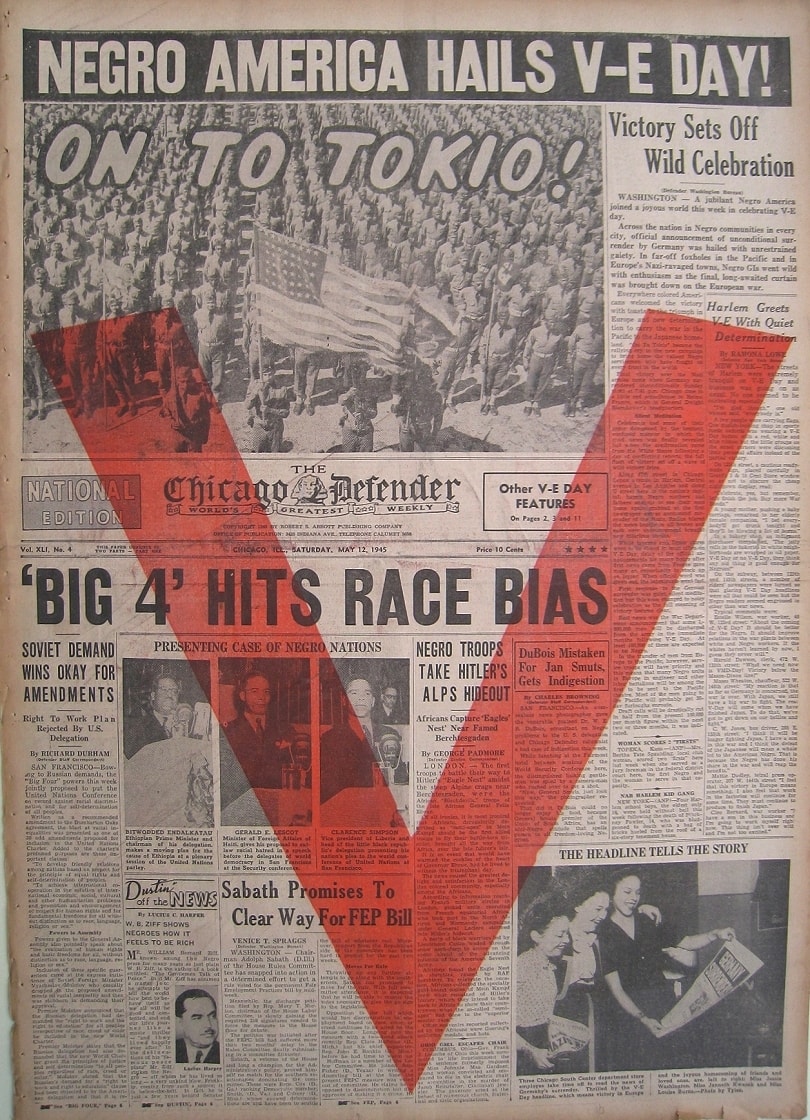
Chicago Defender of May 12, 1945. Famous red “V” edition announces official end of World War II in Europe on May 8.
Founded in 1905 by Robert Sengstacke Abbott (1868-1940), for several decades The Chicago Defender was the largest and most influential “race paper,” presenting news and editorials from a progressive viewpoint. Growing up in the South, Abbott confronted the public’s Jim Crow mindset with a secret “Standing Dealers List” of over 2000 sales agents and Pullman rail porters to expand circulation using black churches, barbershops, hair salons, poolrooms, record stores, grocery stores and restaurants – all places where vibrant discussion would ensue.
The weekly urged southern blacks to flee Jim Crow violence by coming North and West in the course of the two Great Migrations of 1915-1925 and 1940-1970. Even before WW I, the government saw “The Defender” as an existential threat, yet during the war, Abbott backed off pursuing his indictment of the military’s segregationist policies due to W.E.B. Du Bois’ “Close Ranks” stance to suspend protest in deference to the national war effort. However, in 1919, the government covertly obtained the paper’s subscriber and Standing Dealer’s lists to search for communist ties.
Throughout the 1930s, President Roosevelt shunned black reportage at his frequent and well-attended White House news conferences. When Robert Abbott died in 1940, he was succeeded by his nephew, John H. Sengstacke (1912-1997), who formed the Negro Newspaper Publishers Association so a united black press could better represent itself.
During WWII, the Defender again sought to transform the nation by vigorously confronting racism, discrimination and segregation within the military, reporting on black casualties, and publishing copious stories with photos of black troops excelling in combat. It warned about Navy recruiters who promised blacks training as mechanics or radiomen, but whom ended up being cooks or digging latrines, and shockingly exposed the friendlier public treatment of German POWs than for African American servicemen in southern towns.
Working behind the scenes, a now-powerful Sengstacke resisted accusations of sedition, positioned the first black White House Press Corps reporter in 1944, and dangled the black vote before President Harry S. Truman, a factor encouraging him in 1948 to issue Executive Order 9981 banning discrimination within the military.