

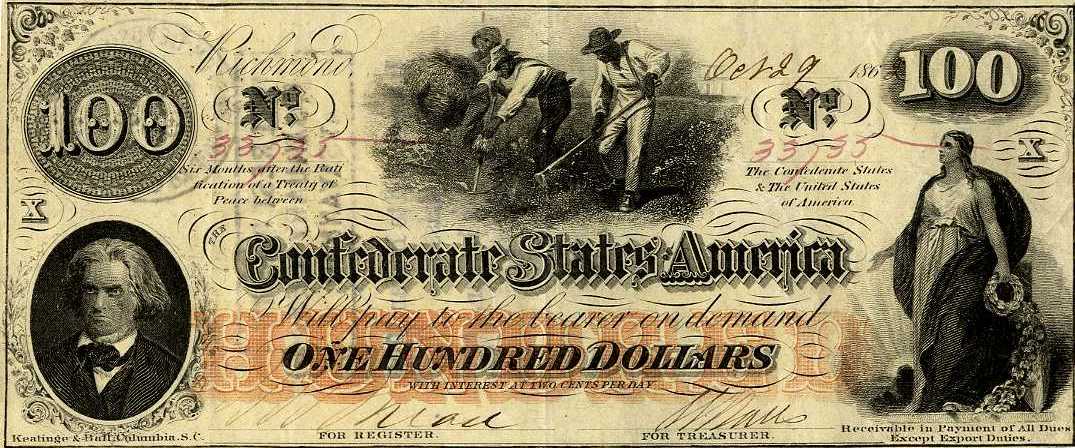
Confederate States of America $100 Note Depicts Slave Labor as the Source of Southern Wealth.
Simply exchanging commodities like cotton for munitions was sometimes accomplished. However, purchasing the necessities of war on a large scale and trading internationally forced the seceding states to issue their own money and bonds in exchange for negotiable instruments such as gold, silver, and foreign currencies. Twelve of the thirteen southern states issued seventy different types of currency during the war and excessive printing led to devaluation averaging ten percent per month.
To infer constitutional legitimacy, Confederate currencies portrayed vignettes of southern statesmen, like Washington, Jefferson, or the dour-looking Senator John C. Calhoun, shown on left, of South Carolina, a two-time U.S. vice-president and father of States’ Rights, who had once proposed secession and called slavery a “positive good.” Nearly all currency depicted the true basis of southern wealth: the enslaved themselves, invariably clean, healthy and well-clothed, contentedly shipping bales of cotton or toiling the fields unsupervised.
The above example contains the government’s promise to pay the bearer face value “With Interest At Two Cents Per Day, Six Months after the Ratification of a Treaty of Peace between The Confederate States & The United States of America.” Prospects at the time for either a military victory or negotiated peace seemed feasible, yet by war’s end a southern dollar was merely worth a penny and a half and the above note was worthless. Printed in Columbia, SC, and issued in Richmond, VA, October 29, 1862.