

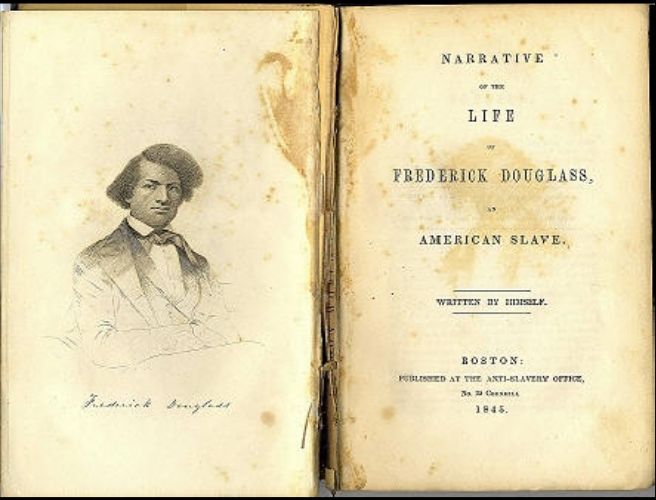
First Autobiography of Frederick Douglass (1818-1895). Rare 1845 First Edition.
Considered by many historians to be the greatest slave narrative ever written, it’s fugitive author’s life story and fiery rhetoric shocked the public and influenced the anti-slavery movement for decades to come.
To wit: “We [slaves] were all ranked together at the valuation. Men and women, old and young, married and single, were ranked with horses, sheep, and swine. Horses and men, cattle and women, pigs and children – all held the same rank in the scale of being, and were all subjected to the same narrow examination, the same indelicate inspection. At this moment, I saw more clearly than ever the brutalising effects of slavery upon both slave and slaveholder.”
Regarding the iniquity of miscegenation with slaves: “The whisper that my master was my father, may or may not be true; and, true or false, it is of but little consequence to my purpose whilst the fact remains, in all its glaring odiousness, that slaveholders have ordained, and by law established, that the children of slave women shall in all cases follow the condition of their mothers; and this is done too obviously to administer to their own lusts, and make a gratification of their wicked desires profitable as well as pleasurable; for by this cunning arrangement, the slaveholder, in cases not a few, sustains to his slaves the double relation of master and father.”
As Douglass named names, thereby alerting his master as to his whereabouts, he fled to the British Isles until money was raised to purchase his freedom. Douglass’s Narrative was followed by My Bondage and My Freedom (1855), and superseded by the Life and Times of Frederick Douglass (1881), covering his involvement during the Civil War.
Frederick Douglass plays such a monumental role as an agitator for Black Liberation that he transcends any single Collection category. Though they met together just three times, his protracted efforts to convince President Lincoln to make the Civil War about slavery by enlisting black soldiers, as well as to challenge the President’s paternalistic and separatist views on recolonizing blacks abroad, would affect not only the war’s meaning, but its very outcome.