

Early Slave Rebellions.
Of the 313 documented slave rebellions, Virginia, the largest slave-state, led the way with 84. South Carolina and Louisiana each had 42.
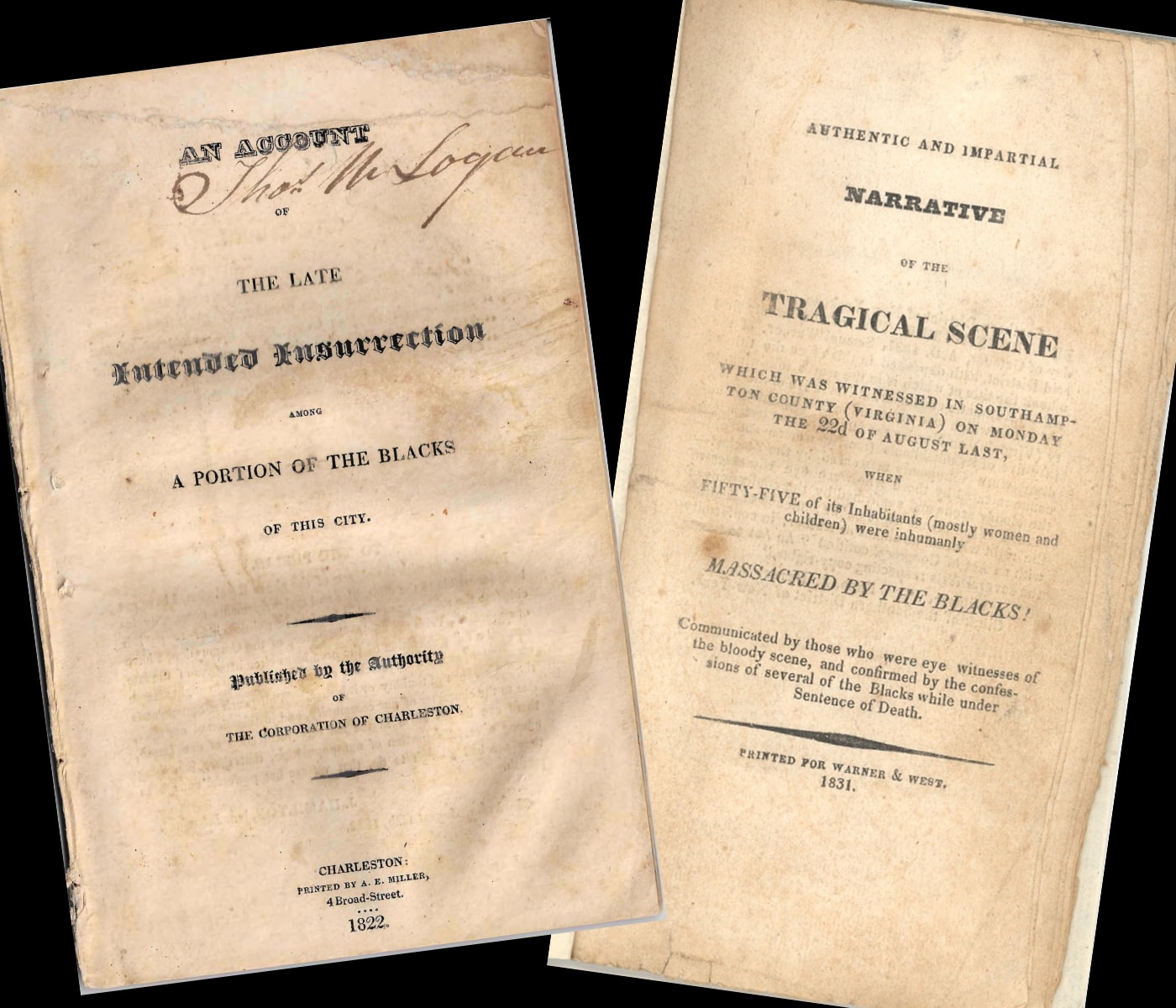
The Denmark Vesey Slave Insurrection. At left, an exceedingly rare first edition official account of the 1822 planned takeover of Charleston, SC, led by Denmark Vesey. Vesey had won the city’s lottery and used the proceeds to buy his freedom. His elaborate plot to free others included the seizure of sea-going vessels and their captains for getaway. The plan was betrayed by a house servant who panicked and informed his master. The Intendant (mayor) of Charleston, James Hamilton, Jr., warns in the frontispiece, “among a certain portion of our population, there is nothing they are bad enough to do, that we are not powerful enough to punish.”
At right, published in New York is the first complete report on the Nat Turner Slave Rebellion of Southampton, VA, in 1831. Believed at the time to be the largest slave revolt in the U.S. with up to 60 white casualties, of the nearly 75 participants, 56 were tried, convicted, and hanged. During the months leading up to Reverend Turner’s capture, some forty free and enslaved blacks may have died in reprisal. This largely firsthand and “impartial” narrative includes confessions and cites Turner’s education, intelligence, and mobility as factors leading many states to enact curfews and laws that forbade bondspersons and freemen alike, to read, travel, assemble, and beat drums. Although it condemns the massacre, it concludes with an admonition against those who would persecute their slaves, and infers that the Bill of Rights protects the enslaved as well.
While none of the North American slave insurrections were ultimately successful, some half dozen came threateningly close, including the vicious German Coast Uprising, along the Mississippi above New Orleans in 1811, of up to 500 slaves led by trained warrior Charles Deslondes, who had been brought to Louisiana after the Haitian Revolution. Quickly suppressed, it was completely covered up to enable the Louisiana Territory to achieve statehood in 1812.