How George and Martha Washington Recovered Mount Vernon’s Bricklayers Among Their 17 Runaways That Fled to British Forces.
Despite ongoing demand, during the War for American Independence, only one solitary slaver had delivered its Africans to England’s thirteen former colonies. Great Britain occupied not only the chief ports of New York, Wilmington, Charleston, and Savannah, its all-powerful navy maintained an effective blockade on lesser ports as well. By war’s end, what few Continental warships remained dared not venture out.
But American privateers had never been so busy. Privateers were privately armed ships sanctioned to attack and plunder vessels of a nation with which they were at war. The risks were great, but when successful their profits could be immense. Even more was to be made by seizing and selling the thousands of free or impressed black sailors and runaways who had fled their masters by sea.
George Washington was known to invest in privateering ventures, and one of the most intrepid privateers was George Geddes of Philadelphia. Geddes had a penchant for being in the right place at the right time, and early in the war had befriended the Supreme American Commander. In September 1779, Geddes sent what General Washington acknowledged in his thank you note at the end of the month, was “the present of a pair of very elegant pistols” that he, in turn, later willed to Lafayette.
However, Captain Geddes proved even more valuable when leading both the capture and restitution of George and Martha’s slaves who had fled to the British.
As was his habit, Royal Navy Captain Charles Stirling, operating under the alias Thomas Graves, sailed his low-draft, 16-gun sloop, “HMS Savage,” past riverfront plantations only to return by daybreak to plunder, shell, and burn them. Thus did the Savage’s boats appear at the Washington’s Mount Vernon dock on April 12, 1781. In deference to the estate’s illustrious owner and in thanks for an abundance of fresh provisions, Stirling left it intact while its neighbors suffered greatly. And, in a bid for their freedom, Stirling invited its bondspersons to join him. Seventeen complied, including Tom Davis (aka Thomas Davis), a skilled bricklayer whose wife was owned by Tobias Lear, Washington’s personal secretary. Tom was a “dower tradesman,” thus owned by Martha as were several of the others.
Customarily of dignified restraint, the general was livid upon receiving the letter his caretaker of six years and distant cousin, Lund Washington, had written him in New York reporting the raid. Most of the escapees were manor house laborers, with a half-dozen field hands from the River Plantation, and one or two from the Ferry Plantation. They were: Peter (15), Thomas (17), Daniel (19), Sambo, Stephen, Tom Davis, and Wally (or Watty, all of them 20), James (25), Harry (40), Frederick and Gunner (both about 45), Deborah (16), Esther (18), and Lucy (20), plus Frank, Lewis, and Peter (all of them “old”). Replying to Lund that he should have let the estate burn, Washington also made formal complaint to the British for the return of his property, but it went unanswered.
Five months later, Captain Geddes in the privateer “Congress” was returning from Cap-François, Haiti, having carried dispatches from Gen. Washington to Admiral François Joseph Paul de Grasse, commander of France’s Caribbean fleet, ordering its support for either Washington, still in New York, or for General Rochambeau, who faced Lord Cornwallis entrenched on a narrow peninsula at Yorktown, Virginia. De Grasse chose the latter.
Following barely a week behind the French fleet, on September 6, 1781, Geddes encountered the “HMS Savage” escorting a convoy of merchant ships off Charleston, South Carolina. Captain Stirling responded by steering toward the stranger, but turned away once he discovered the 24-gun “Congress” to be a superior vessel. After several hours chase and fierce broadside duels, considered one of the hardest-fought sea actions of the war, Geddes overtook the Savage and cut in front, driving his bowsprit into his quarry’s at a wide angle allowing him to bring his starboard guns to bear on the helpless victim.
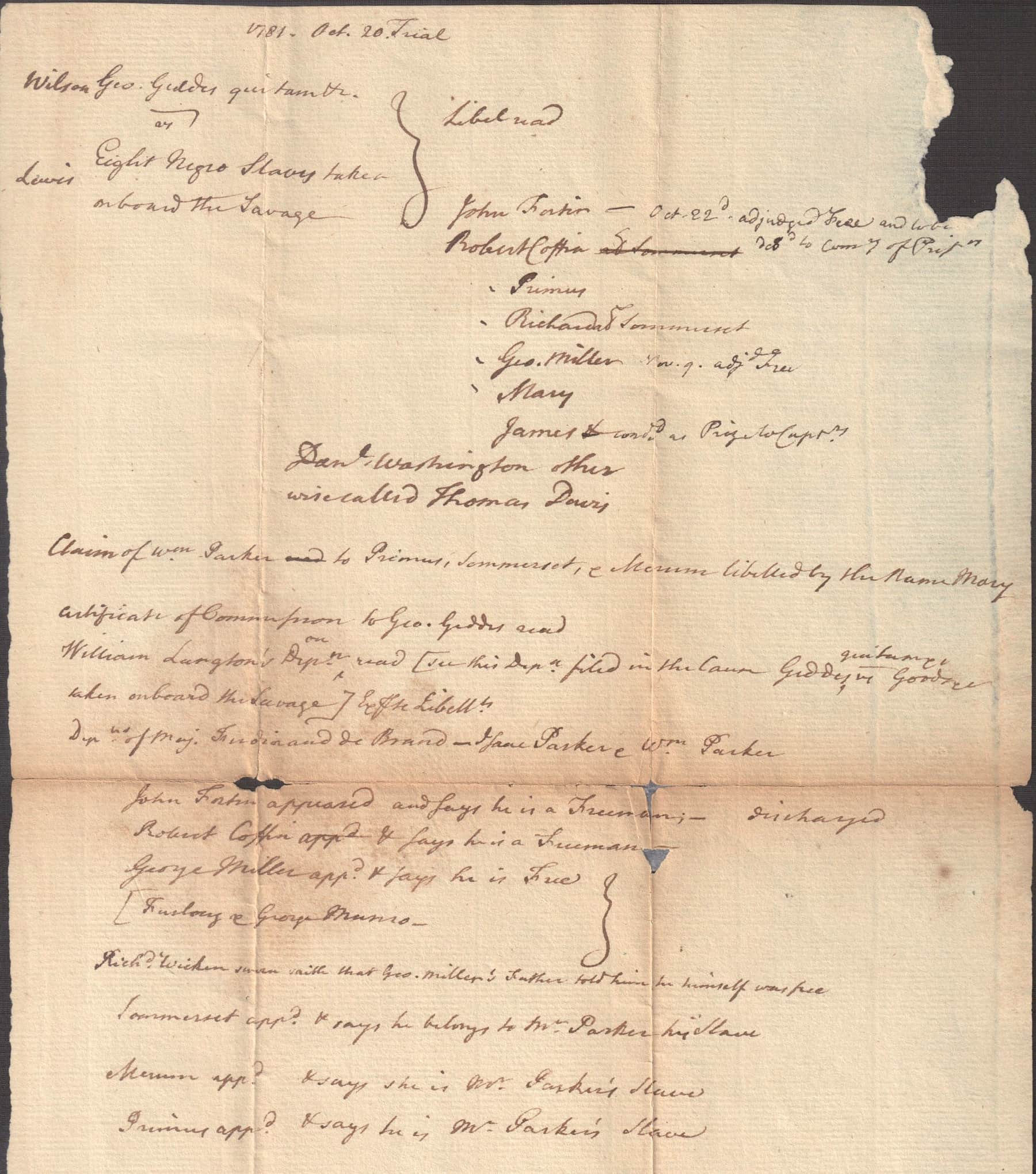
It is well-known that seven of the Washington’s slaves who boarded the Savage were recovered at sea by Captain Geddes, but not what transpired afterwards. Here, for the first time is the story of a long-lost document that proves how this was orchestrated, perhaps in secret.
Above, brought to trial on October 20, 1781, at an unnamed tribunal, most likely a Court of Vice-Admiralty, are a group of eight slaves taken off the Savage by Geddes and his crew. Besides Geddes’ privateering “Certificate of Command,” is read the deposition of crewmember, William Langton, “when onboard the Savage.” The docket on the reverse cites: “Minutes Geo. Geddes qui tam v. Eight Negro Slaves taken on board the Ship Savage.” (In common law, qui tam is a writ where private individuals who assist in prosecution may receive all or part of any penalty imposed.) Geddes and his crew were thus entitled to keep or sell any slaves they captured for whom the court could find no lawful owner. This is followed by “Vide [meaning See] Docquet March 26, 1782.”
Curiously, the summary notes that Geddes has a similar case pending, possibly, “Geddes qui tam v. Goodsen” (the last three letters are illegible), where Langton’s deposition was also presented. We have no clue what it revealed about Washington’s fifteen additional slaves, whether any were serving as sailors or had been among the Savage’s 8 killed and 34 wounded.
It appears an attorney named Wilson is acting for Geddes, and a Mr. Lewis represents either the defendants or their legal owner. Two slaves are discharged and freed, one is referred to another court, and three are returned to a claimant named William Parker after one admits she had “libelled” by changing her name. Geddes is awarded the two remaining slaves, one being James, while the other, who assumed the name Daniel Washington, is either Tom Davis or Daniel himself. This is cryptically mentioned: “James award’d as Prize to Capt’n. Dan’l Washington other wise called Thomas Davis.” Proudly or defiantly, whoever he was identified as having been Washington’s recent property.
Four years later, in George Washington’s diary entry of February 18, 1786, he inventories his and Martha’s 216 slaves. Of the three possibilities awarded Geddes, only Tom Davis and someone named James appear among Mount Vernon’s enslaved. Daniel does not. The accounting includes six captured aboard the Savage: Frank (a “Stock keeper old jobber”); laborers, Esther and Lucy; and brickmakers and layers, Gunner, Tom Davis, and Sambo. The seventh recovered, Frederick, an overseer, who by this time would have been about 50, may have died or run away. The names of other Savage escapees that appear in the ledger specify a “James” (who labors alongside Gunner, Tom, and Sambo), and two Peters (one of whom is without occupation and certainly old). James and Peter are very common names and we cannot assume they’re the same persons, but circumstantially, up to ten of the seventeen may have been recovered.
Unfortunately, the full transcript of the court’s proceedings (for some reason dated five months later), William Langton’s deposition, as well as Geddes’ other qui tam case have never been located – perhaps for the general’s benefit. It could be that someone misplaced or overlooked this single-page court summary. Speculation aside, the Mitchell Collection’s partial but incriminating evidence proves that Captain Geddes deftly interceded on Washington’s behalf on land as well as at sea.
Moreover, Washington was still Commander-in-Chief of the Continental Army and had everywhere achieved god-like status. The future first president considered himself an exemplary, if reluctant slaveholder, and both he and Martha were thoroughly embarrassed by their chattel’s escapes which by their deaths numbered around fifty.
The Washington’s jointly owned slaves eventually numbered 316, and Washington fretted over Mount Vernon’s operating at a loss when it required but 100 to be profitable. In any event, the great man held no grudges and included the Savage’s former passengers among the 124 personally owned slaves named in his will (see a copy under Religion). While the general’s devoted and longtime body servant, Billy Lee, was freed “outright,” his remaining chattels were freed by Martha a year later.