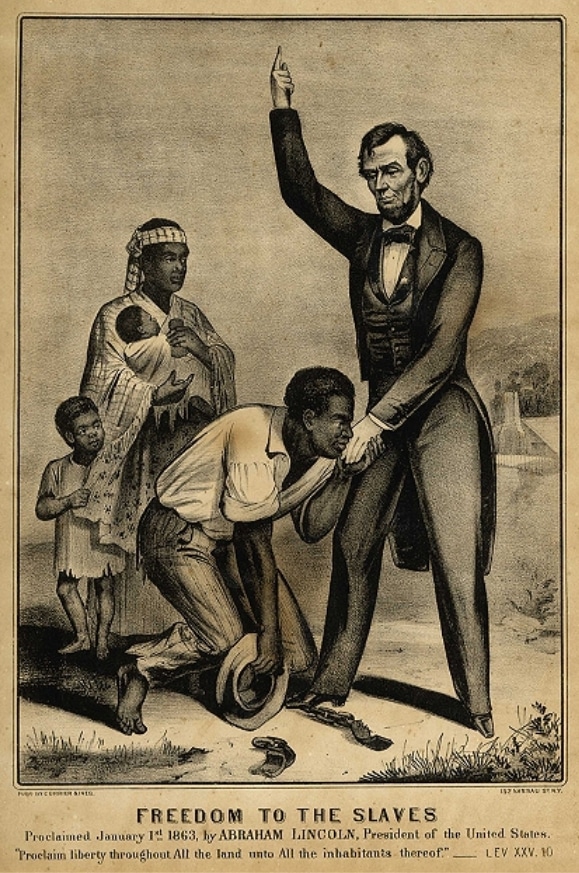
1863 Currier & Ives Print Commemorates President Lincoln’s Emancipation Proclamation.
The image portrays a freedman with shackles removed, crouching and kissing Lincoln’s hand, but now being raised from his knees while his wife and children look on. At times, former slaves would unashamedly kneel before the president at which point Lincoln would raise the person up with the admonishment that they “kneel to no one but God.”
Today, many question Lincoln’s mantle as “The Great Emancipator,” by criticizing his racial bias and reticence to free every bondsperson when he could have done so in the Proclamation. As an accomplished trial lawyer, however, Lincoln had learned how to precisely “read” juries, and understood that only by degree, kicking and screaming, would America come to abandon its addiction to Slavery, even in the midst of civil war.
As abolitionist Lydia Maria Child put it:
“But, after all, it would not be fair to blame the President for moving so slowly. The people were not prepared to sustain him in any such measure; they had become too generally demoralized by long subservience to the Slave Power.”
During his second inaugural address on March 4, 1865, Lincoln stated, “One eighth of the whole population were colored slaves, not distributed generally over the Union, but localized in the Southern part of it. These slaves constituted a peculiar and powerful interest. All knew that this interest was, somehow, the cause of the war.”
As to the war’s divine purpose, he added, “Yet, if God wills that it continue until all the wealth piled by the bondsman’s 250 years of unrequited toil shall be sunk, and until every drop of blood drawn with the lash shall be paid by another drawn with the sword, as was said 3,000 years ago, so still it must be said ‘the judgments of the Lord are true and righteous altogether.'”