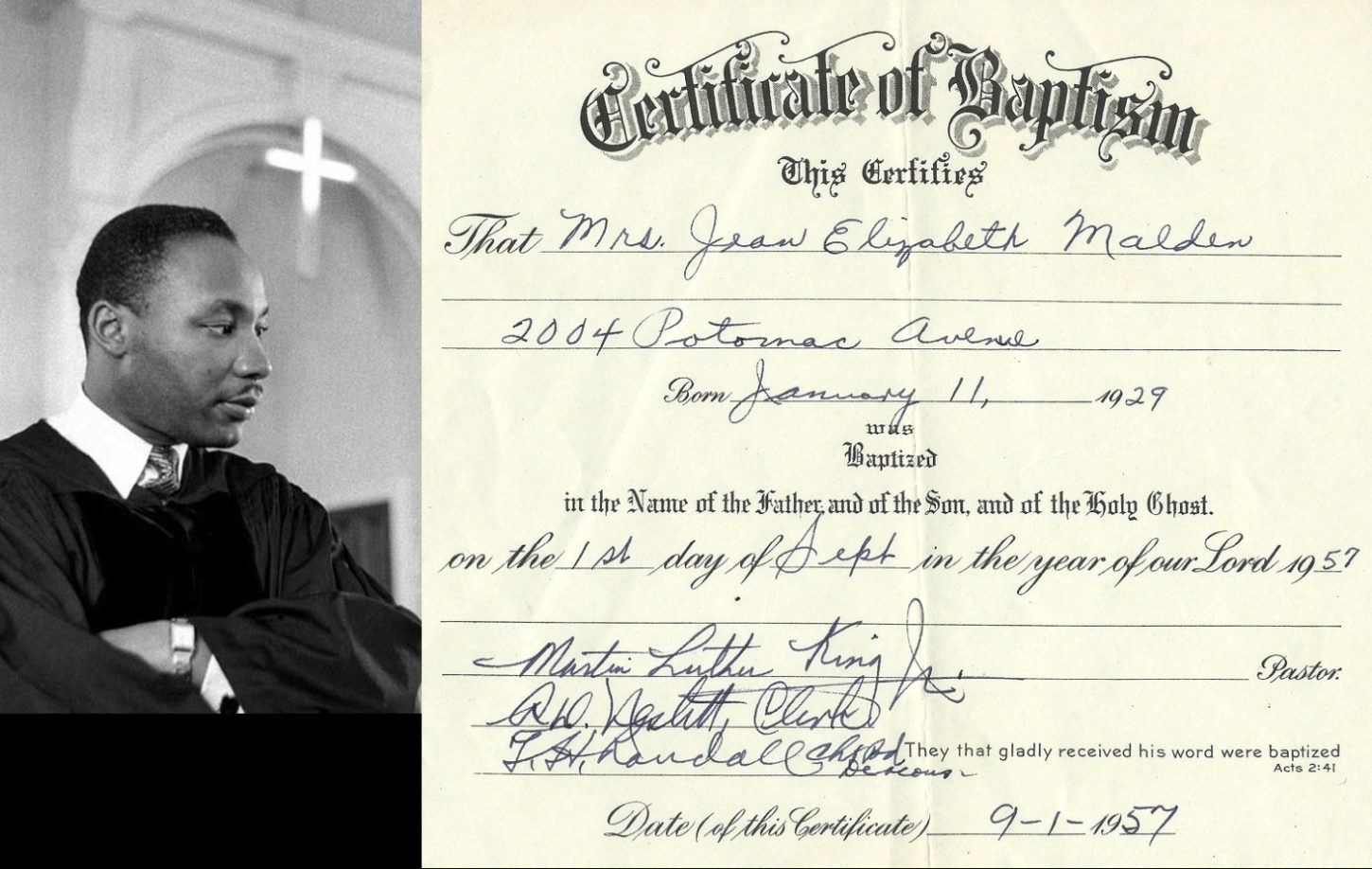
1957 Baptismal Certificate Signed by the Reverend Martin Luther King, Jr., at Dexter Avenue Baptist Church, Montgomery, AL.
It is extremely rare to come across any signed items that portray King’s ecumenical leadership since most documents, letters, books, photos, film clips, and quotations are related to his heroic role in the Civil Rights Movement. Consequently, according to the late Julian Bond, writing in 1993, “… we celebrate only half of Dr. King’s dream.”
Above, a Certificate of Baptism signed by Reverend King as “Pastor,” attests to the 1957 christening of Mrs. Jean Elizabeth Malden, age 28, at the Dexter Avenue Baptist Church where she was a member. Pastor King, the officiant for the service, had headed the church since 1954 and directed the famous Montgomery Bus Boycott from its basement in 1955.
King recalled from that period, “In 1957, when a group of us formed the Southern Christian Leadership Conference, we chose as our motto, ‘To save the soul of America.’ We were convinced that we could not limit our vision to certain rights for black people.”
After receiving his Nobel Peace Prize in 1964, Reverend King used the platform the following year to denounce U.S. involvement in Vietnam and its impact on African American communities at home. The stance distanced him not only from President Lyndon Johnson, but a great many former allies. It was not in vanity that he said of himself at the time, “I’m much more than a Civil Rights leader.” And in 1966, King told his father’s Atlanta congregation, “There must be a better distribution of wealth … We can’t have a system where some of the people live in superfluous, inordinate wealth while others live in abject, deadening poverty.”
Moving his family north to one of Chicago’s worst slums that January, King renewed his vision by announcing a Poor People’s Campaign during an SPLC staff retreat in November 1967. Intending that the campaign travel nationwide in demanding jobs, fair minimum wages, unemployment insurance, and educational opportunity, King was killed just six weeks before his plan commenced with a massive encampment in Washington, DC, from May 14 to June 24, 1968, that included impoverished Latinos and whites from Appalachia.
In one of Reverend King’s final speeches, addressing the striking sanitation workers he had come to Memphis, Tennessee to support, he declared, “What does it profit a man to be able to eat at an integrated lunch counter if he doesn’t have enough money to buy a hamburger?”