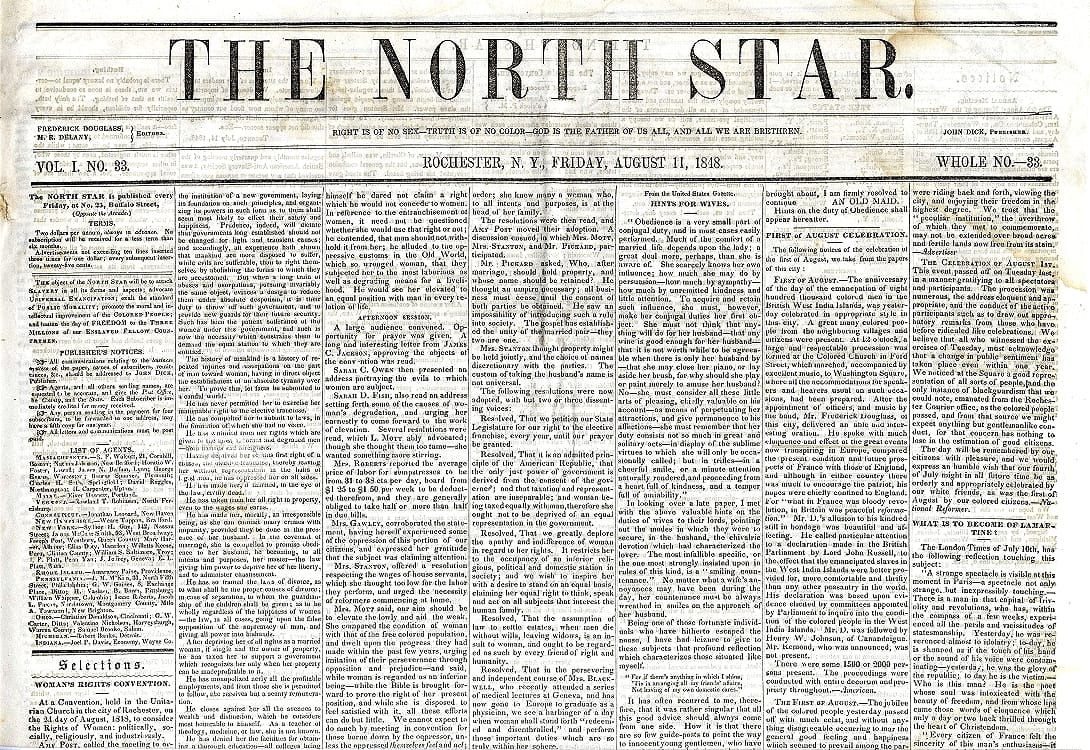
Frederick Douglass’ THE NORTH STAR newspaper. Published in Rochester, NY, this Volume I, No. 33 edition of August 11, 1848, contains a front page printing of the “Declaration of Sentiments” from the recently-concluded historic first Women’s Rights Convention at Seneca Falls, NY, which Douglass himself attended. The publication’s motto was, “RIGHT IS OF NO SEX – TRUTH IS OF NO COLOR – GOD IS THE FATHER OF US ALL, AND ALL WE ARE BRETHREN.” Douglass’ North Star masthead represented the guiding light for fugitives heading towards freedom. The above newspaper is thought to be one of only two known of this issue.
Upon Douglass’s return to America following a self-imposed exile in the British Isles, he decided to publish his own anti-slavery newspaper, choosing Rochester instead of Boston or New York City in order not to interfere with the local circulation of William Lloyd Garrison’s Liberator or the National Anti-Slavery Standard. In a letter to his friend Amy Post, Douglass wrote: “I have finally decided on publishing the North Star in Rochester and to make that city my future home.” Douglass began his weekly newspaper on December 2, 1847. William Cooper Nell was the publisher, and John Dick, the printer. Among the early patrons of the North Star, was abolitionist and wealthy philanthropist, Gerrit Smith.
In May 1851, after attending the annual meeting of the American Anti-Slavery Society, Douglass broke ranks, refusing to condemn the U.S. Constitution as a pro-slavery document, demanding instead that it “be wielded in behalf of emancipation.” His view greatly angered the Society which then passed a resolution against newspapers that supported the Constitution. Discarding the famous title of his newspaper in June 1851, Douglass began a new publication, Frederick Douglass’ Paper, in open defiance of the Society. However, his “official” reason for the change was to differentiate his paper from the many using the word “Star” in their masthead.
Over The North Star’s three and a half years of existence, Douglass wrote about the many local and state-wide anti-slavery meetings and conventions. He included reports from abolitionist societies, important speeches, resolutions adopted, and the size and enthusiasm of the audiences. Like other newspapers, the North Star contained articles lifted from other publications around the nation, and articles written by a number of correspondents. Advertisements contain the various publications printed and sold by the North Star Press, including Douglass’s own books and speeches.