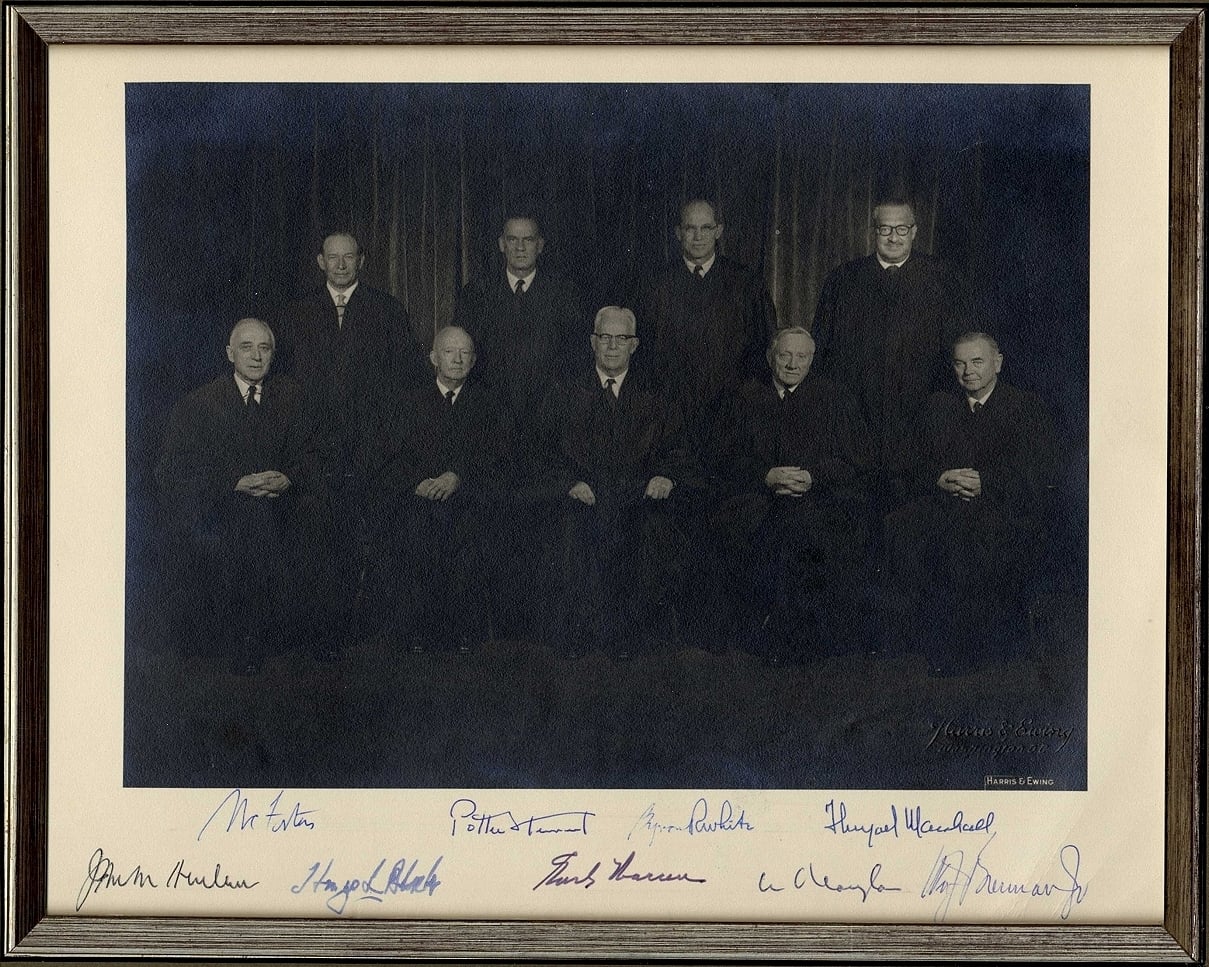
Thurgood Marshall, The First African American Supreme Court Justice.
The Warren Court broadly interpreted the Constitution to provide greater protections for individual rights. In this signed group photo, Marshall is pictured on the top row at right.
After winning 29 of the 32 cases Marshall pleaded before the Supreme Court, “TM” became the first African American U.S. solicitor general. Then, in 1967, President Lyndon B. Johnson appointed Marshall an associate justice to the Supreme Court. TM and his colleague and judicial soul mate, Justice William Brennan, played a large part in translating what had at first been dissenting views into established jurisprudence. Together they led the Court in accelerating the Civil Rights Movement, with race-based affirmative action, reforming police practices, and sex discrimination, among others.
Perhaps as important to Africans Americans as Brown v. Board of Education, was the Baker v. Carr, decision of 1962: That because the nation’s increasingly urbanized areas lagged behind rural ones in receiving funds necessary for roads, education, and social services, the Court ruled 6 to 2, that federal courts could litigate cases where states had not reapportioned their voting districts since 1901, and established the Court’s famous “One person, one vote” principle.
Many took issue with the Court’s progressive departures from the Founder’s intent – that instead, the Constitution could be an adaptable, living force for the social and political change to cope with the current problems and present needs of all Americans. After retiring in 1991, Marshall was succeeded by Clarence Thomas, another African American. After Marshall’s death, the Washington Afro-American may have stated his accomplishments best:
We make movies about Malcolm X, we get a holiday to honor Dr. Martin Luther King, but every day we live with the legacy of Justice Thurgood Marshall. – Juan Williams