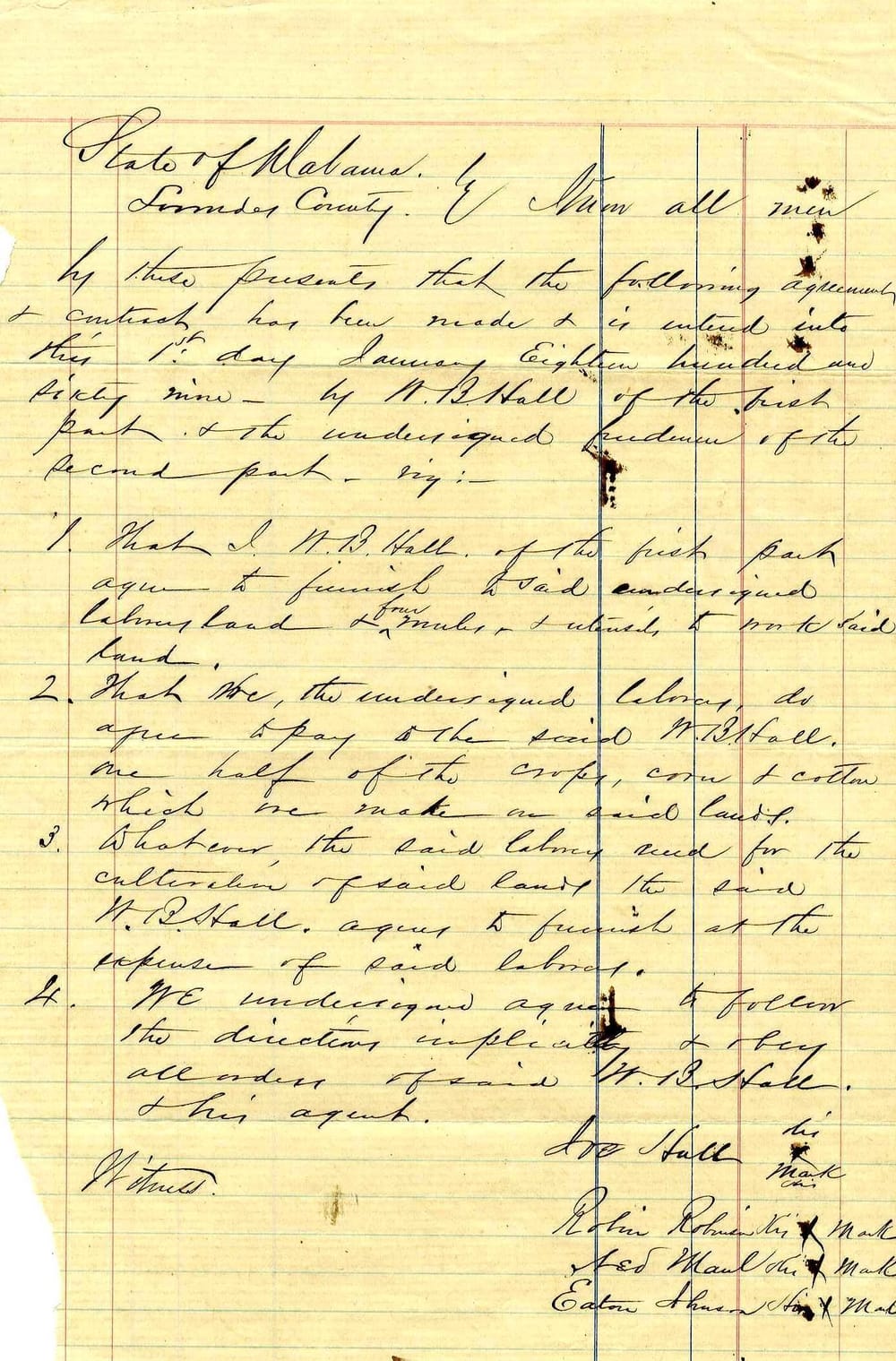
1869 Sharecroppers’ Agreement.
This blatantly homemade legal contract from Lowndes County, Alabama, on January 1, 1869, and inappropriately witnessed by an illiterate family member, nonetheless illustrates the only post-war economic opportunity available to most freedmen other than toiling for former masters at minimal wage. No expiry date is given, so it may be an annual renewal of a more formal contract.
Three illiterate ex-slaves each sign with an “X,” customarily agreeing to till land for half the crops and cotton they produce and giving the remainder to the landowner who usually dictated the terms. Though very informal compared to our 1865 example, tenants similarly agree to “follow the directions implicitly & obey all orders of said N.B. Hall & his agent,” although there are no provisions made for clothing, medical care, or legal redress.
Within the decade, holding a sharecroppers’ agreement avoided the charge of vagrancy for merely appearing in public without a few dollars at hand. Such false charges and trifling convictions, like failing to repay a debt, brought sentences from 30 days in jail to life in a penitentiary. As time went on, agreements became even less formal, verbal, or managed by absentee landlords, rendering protection useless and thus preventing tenants from relocating.
Once aimed at keeping poor southern whites subdued, “Debt Peonage” and “Convict Leasing” criminalized both blackness and poverty, with freedmen working indeterminate terms, often to death at hard labor, for individuals, corporations, or the states themselves. It was slavery by another name, and frequently, said some who knew it firsthand, much worse.