

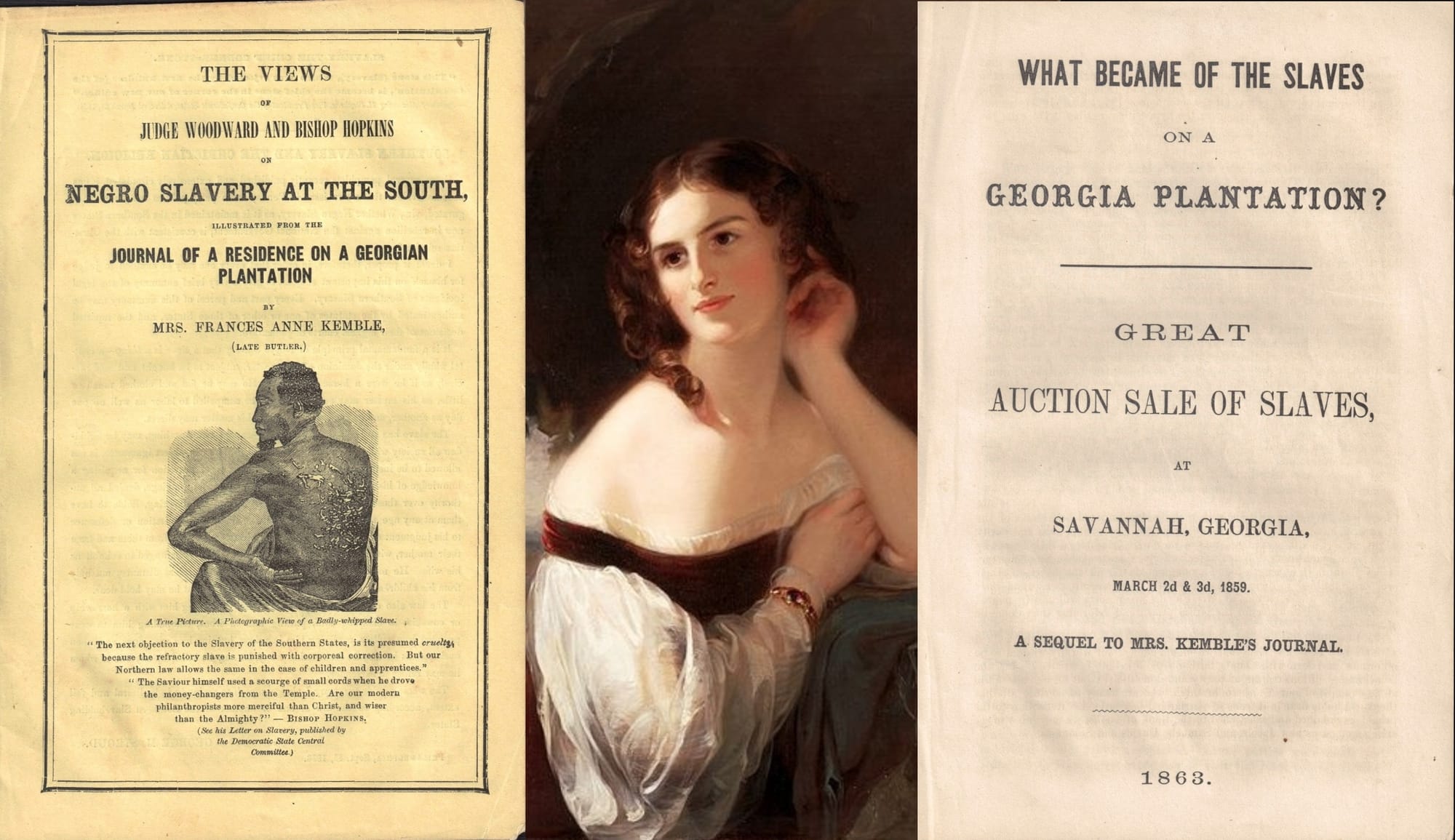
“The Weeping Time,” the Largest Sale of Slaves in U.S. History – And the Most Intimate Record of Plantation Slavery Ever Witnessed by an Abolitionist.
Although the “Great Auction Sale of Slaves” occurred a full two years before the Civil War began – and a beautiful international celebrity’s exposé of slavery’s horrors itself was not released until 1863 – their telling, in more accessible and affordable pamphlet sequels, confronted southern apologists and added moral suasion to Lincoln’s Emancipation Proclamation.
At left, “Negro Slavery at the South, Illustrated from the Journal of a Residence on a Georgian Plantation by Mrs. Frances Anne Kemble (Late Butler.).” This 36-page pamphlet is a five-chapter addendum to Ms. Kembles’s scathing indictment of southern slavery (“Journal of a Residence on a Georgian Plantation in 1838–1839″). Excerpts from her decades-old recollections are used to refute the 1860 pro-slavery speech of Judge George Washington Woodward and the and still more extraordinary 1861 pro-slavery letter of Episcopalian Bishop John Henry Hopkins. First edition, Harper & Brothers, New York, 1863.
First published in London in February 1863, popular actress Fanny Kemble’s book came at a time when British sympathies sided squarely with the Confederacy which relied on both English munitions and its construction of fast blockade runners in exchange for the cotton that fed its textile mills. Harper Brother’s American printings of both the book and pamphlet in mid-1863 helped shape the Union cause of emancipation, a cause Britain itself had championed since 1833. In bravely exposing southern brutality and depravity as well as countering its assertions, Kemble became the world’s first popular entertainer to champion human rights.
The pamphlet’s cover and frontispiece bear the famous image of Gordon, a slave, who in March 1863 escaped and reached Union lines 80 miles away at Baton Rouge, Louisiana. His scarring, the result of an overseer’s brutal whipping, was discovered during his Army enlistment. His iconic pose, captured by local photographers McPherson and Oliver, was reproduced in Harper’s Weekly and on many thousands of CDVs. Over the next few months, Gordon fought bravely with black troops in the 48-day siege of Port Hudson, LA, in securing federal access to the entire Mississippi River, eventually becoming a sergeant.
At right, “What Became of the Slaves on a Georgia Plantation? Great Auction Sale of Slaves, at Savannah, Georgia, March 2d & 3d, 1859, A Sequel to Mrs. Kemble’s Journal,” 20 pp., 1863. The pamphlet is a reprinting of the firsthand account of an undercover reporter sent by Horace Greeley, the famous abolitionist editor of The New York Daily Tribune. First reported in Greeley’s paper on March 9, 1859, it covered Kemble’s ex-husband’s auction of 429 slaves at a Savannah racecourse, interviewed bidders from across the South, the auctioneers, and the slaves themselves, presenting discomfiting insight on Southerners’ treatment of their bondspersons. In part:
“Major Butler, dying, left a property valued at more than a million of dollars, the major part of which was invested in rice and cotton plantations, and the slaves thereon, all of which immense fortune descended to two heirs, his sons, Mr. John A. Butler, sometime deceased, and Mr. Pierce M. Butler, still living, and resident of the City of Philadelphia, in the free State of Pennsylvania. Losses in the great crash of 1857-8, and other exigencies of business, have compelled the latter gentleman to realize on his Southern investments, that he may satisfy his pressing creditors.”
“The negroes were examined with as little consideration as if they had been brutes indeed; the buyers pulling their mouths open to see their teeth, pinching their limbs to find how muscular they were, walking them up and down to detect any signs of lameness, making them stoop and bend in different ways that they might be certain there was no concealed rupture or wound; and in addition to all this treatment, asking them scores of questions relative to their qualifications and accomplishments. All these humiliations were submitted to without a murmur, and in some instances with good-natured cheerfulness – where the slave liked the appearance of the proposed buyer, and fancied that he might prove a kind ‘Mas’r.’”
The Tribune’s reporter cited that 436 slaves had been advertised, including 30 babies, with 429 sold in groupings of spouses and their non-adult children, netting $303,850 (about $9 million today). Upon its successful conclusion, the auctioneers hosted a champagne party for the bidders, whereupon Mr. Butler gifted four 25-cent pieces to each of his former slaves. At at the slaves final partings, with family, kinship and engagements severed, the correspondent summed, “… these scenes pass all description; it is not meet for pen to meddle with tears so holy.”
At center, Fanny Kemble, in a Thomas Sully portrait from 1834 that today hangs in the White House. Kemble was a renowned British-born stage-actor who impulsively married Pierce Butler that year, not knowing the source of his wealth, and by the time she realized the truth it was too late. When Pierce inherited his father’s vast cotton and rice plantations in 1838, Fanny insisted on traveling with their two daughters to Georgia to visit one at St. Simon’s Island and the other near the Okefenokee Swamp, in Darien. Not prepared for their horrors, she stayed less than four months, from December 30, 1838 to April 17, 1839. Henceforth, she pressed her husband to turn against slavery and emancipate his human property, but he remained unmoved and their daughters, too, became permanently divided over the curses and benefits of slavery.
The couple divorced in 1849. Owing to his stock and gambling losses during the market crash the previous two years, as well as their bitter divorce and custody battle, Pierce was forced to sell his Philadelphia mansion and half of his slaves from each plantation. Pierce’s precarious situation was thus alleviated at the expense of his enslaved. Herded away and illiterate, most never saw one another again. Adding to the grief they called “the Weeping Time,” these unbroken generations had to this point managed to preserve much of their African tongue, lineage, folkways, and traditions due to their remote locations.
Despite spending less than seventeen months in Georgia, Kemble collected her years of journaling into a book describing the ever-present woes and terrors of plantation life. In one chapter, repeated in the pamphlet, she counters the myth of southern chivalry by explaining the hopeless state of women’s rights in the South. At a local hospital, Kemble heard the petitions of female slaves who were susceptible to force and coercion in bearing the children of owners and overseers in return for escaping backbreaking field work for several months. In consequence, they suffered brutal recriminations by soulless plantation mistresses who only needed to see a Mulatto child to blame them for seducing their husbands. She continues:
“Sarah, Stephen’s wife: this woman’s case and history were alike deplorable. She had had four miscarriages, had brought seven children into the world, five of whom were dead, and was again with child. She complained of dreadful pains in the back, and an internal tumor which swells with the exertion of working in the fields; probably, I think, she is ruptured. She told me she had once been mad and had run into the woods, where she contrived to elude discovery for some time, but was at last tracked and brought back, when she was tied up by the arms, and heavy logs fastened to her feet, and was severely flogged. After this she contrived to escape again, and lived for some time skulking in the woods, and she supposes mad, for when she was taken again she was entirely naked. She subsequently recovered from this derangement, and seems now just like all the other poor creatures who come to me for help and pity. I suppose her constant childbearing and hard labor in the fields at the same time have produced the temporary insanity.”
“I have had a most painful conversation with Mr. [Butler], who has declined receiving any of the people’s petitions through me.”
“Perhaps, after all, what he says is true: when I am gone they will fall back into the desperate uncomplaining habit of suffering, from which my coming among them, willing to hear and ready to help, has tempted them. He says that bringing their complaints to me, and the sight of my credulous commiseration, only tend to make them discontented and idle, and brings renewed chastisement upon them; and that so, instead of really befriending them, I am only preparing more suffering for them whenever I leave the Place, and they can no more cry to me for help. And so I see nothing for it but to go and leave them to their fate; perhaps, too, he is afraid of the mere contagion of freedom which breathes from the very existence of those who are free; my way of speaking to the people, of treating them, or living with them, the appeals I make to their sense of truth, of duty, of self-respect, the infinite compassion and the human consideration I feel for them — and this, of course, makes my intercourse with them dangerously suggestive of relations far different from anything they have ever known; and, a Mr. 0– [an overseer] once almost hinted to me, my existence was an element of danger to the ‘institution.’ If I should go away the human sympathy that I have felt for them will certainly never come near them again.”
After the war, Fanny Kemble returned to the theatre and led a prodigious literary career, dying peacefully in London in 1893, while Pierce Butler and his pro-slavery daughter Frances, who had spent the war years together in Philadelphia, returned to Butler Island’s cotton plantation where many of their former slaves settled after whites evacuated in 1862. The Butler slaves had also figured prominently in the short-lived federal land redistribution program advocated by Maj. Gen. William Tecumseh Sherman towards the end of the war. Recovering his Sea Island property from the Army, Pierce signed them on as sharecroppers until his death from malaria in August 1867.