

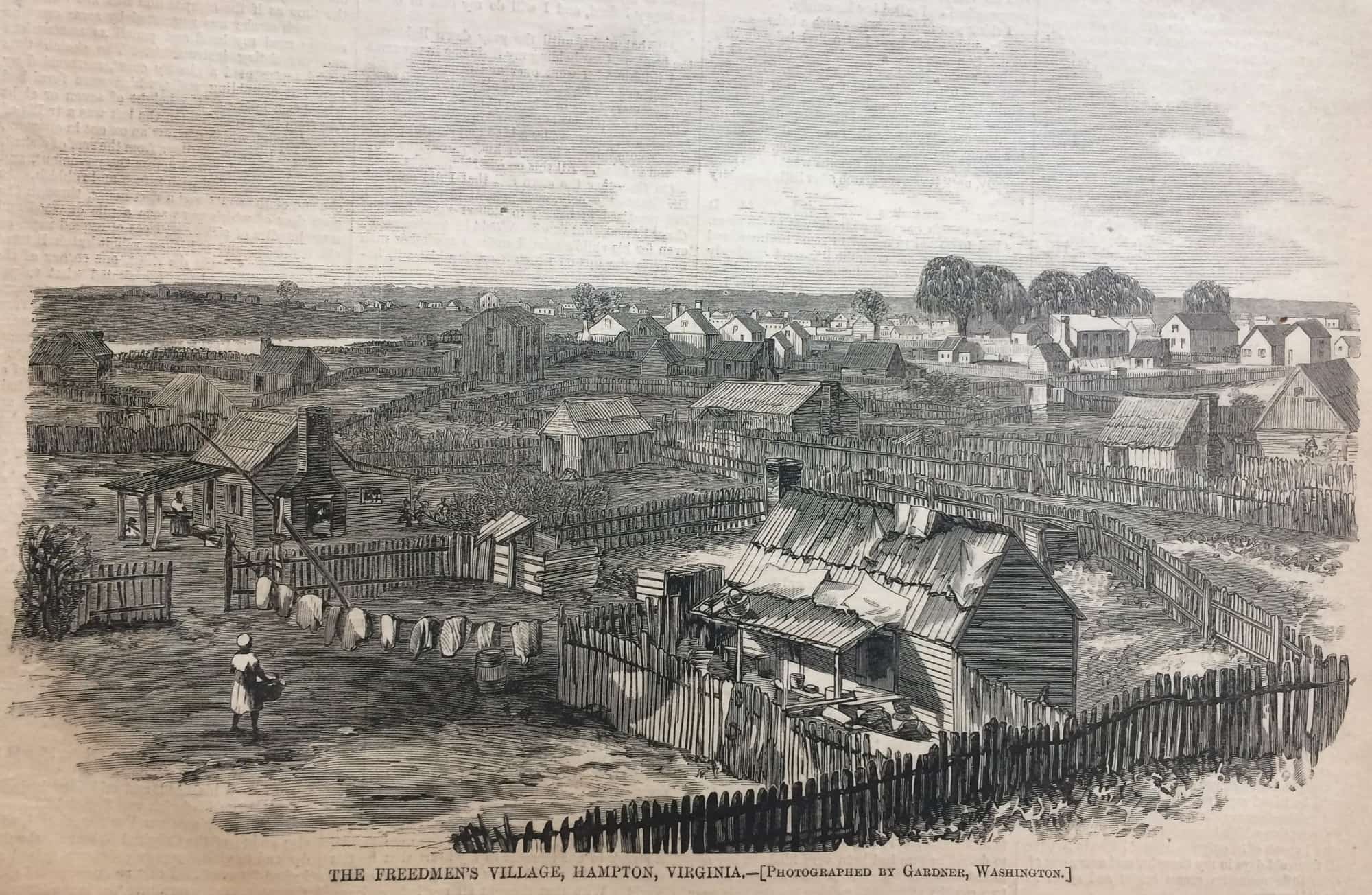
Hampton Virginia’s “Slabtown” As Depicted Six Months After the War.
Early in the war, Tidewater Virginia’s escaped slaves and their families sought shelter in tents at federal encampments. Over time, three Virginia Tidewater contraband camps were established to accommodate an influx of 15,000 refugees from as far away as Tennessee and South Carolina. The name slabtown refers to the odds and ends they used to build more durable shanties which were often adjacent to undamaged chimneys.
Popularly known as “slabtowns,” the first was Camp Hamilton, constructed outside the entrance to Fort Monroe. Described in a news article below, the Grand Contraband camp, at its peak, was said to house a community of 9,000. A third much smaller camp, Freedom’s Fortress, was formed beyond the town of Yorktown and survived until the 1970’s when it was razed by the National Park Service for the restitution of its historic battlefield.
There were eventually more than 100 contraband camps in federally held areas, the most famous being Freedman’s Village, from 1863 until the 1890s, a utopian experiment of the War Department and Freedmen’s Bureau, located on General Robert E. Lee’s confiscated Arlington House manor just across the Potomac from Washington, DC. Mississippi’s Corinth Contraband Camp was also claimed the largest with 6,000 inhabitants.
With the war over for almost six months, the short article, “A Freedmen’s Village,” in Harper’s Weekly on September 30, 1865, attempts to give the public a rare glimpse of the freemen’s autonomy with no apparent end in sight.
On pages 613 and 614, in part:
“The visitor to the site of what was once the little village of Hampton, Va., burned by the rebels in the winter of 1861, will see little to remind him of the place as it existed before the war. The ruins of the little brick church are the only token of the former times. Hampton is now peopled chiefly by freedman, who number about four thousand, most of whom occupy the interesting little village known as Slabtown, of which we give a sketch on this page.
As in all instances where negroes are gathered together into communities, there are in Slabtown features of curious interest. There is a general uniformity both in the material and style of the architecture, the dwellings being built of rough barrel-staves, or slabs split out with an axe. The houses are one story, without attic or basement. Shoe-shops and restaurants are built on the same plan, a few feet reduced. There are two or three public squares, which would probably not compete with the Boston Common.
How all these people support themselves is a mystery to the visitor. An unusual proportion of the negroes are brought up to shoemaking. Some sell tobacco and beer, though it is a miracle where where so many buyers come from in a community where every body seems to have for sale the same articles. What with fishing, doing odd jobs here and there for the farmers up the Peninsula, blacking boots, selling lemonade to soldiers, working in the quarter-master’s department, the denizens of Slabtown manage to exist and enjoy whatever there is of comfort at Old Point, which, as a watering place for white people, will not revive for many years.”
Despite the assistance of public and private programs to recruit soldiers, hire federal laborers, and promote literacy, life in the slabtowns often proved difficult and many left as opportunities arose. At war’s end, the slabtowns quietly disappeared as whites regained political influence and ownership of land. It so happened that Hampton’s largest landowner soon died bankrupt, but unlike the unfortunate renters at Arlington’s tidy Freedman’s Village, its freedmen were able to purchase their plots and homes from the probate court for $75.00 apiece. Hampton thrived and remains one of the most vibrant and racially diverse regions in Virginia.
Another exception was Chesterbrook, a slabtown on the outskirts of Washington, DC. Erected near present-day CIA Headquarters in McLean, Virginia, some of its descendants remained in the area until the mid-1950s. But like most slabtown sites, owners of Chesterbrook’s sumptuous homes and manicured lawns have no idea it ever existed.