

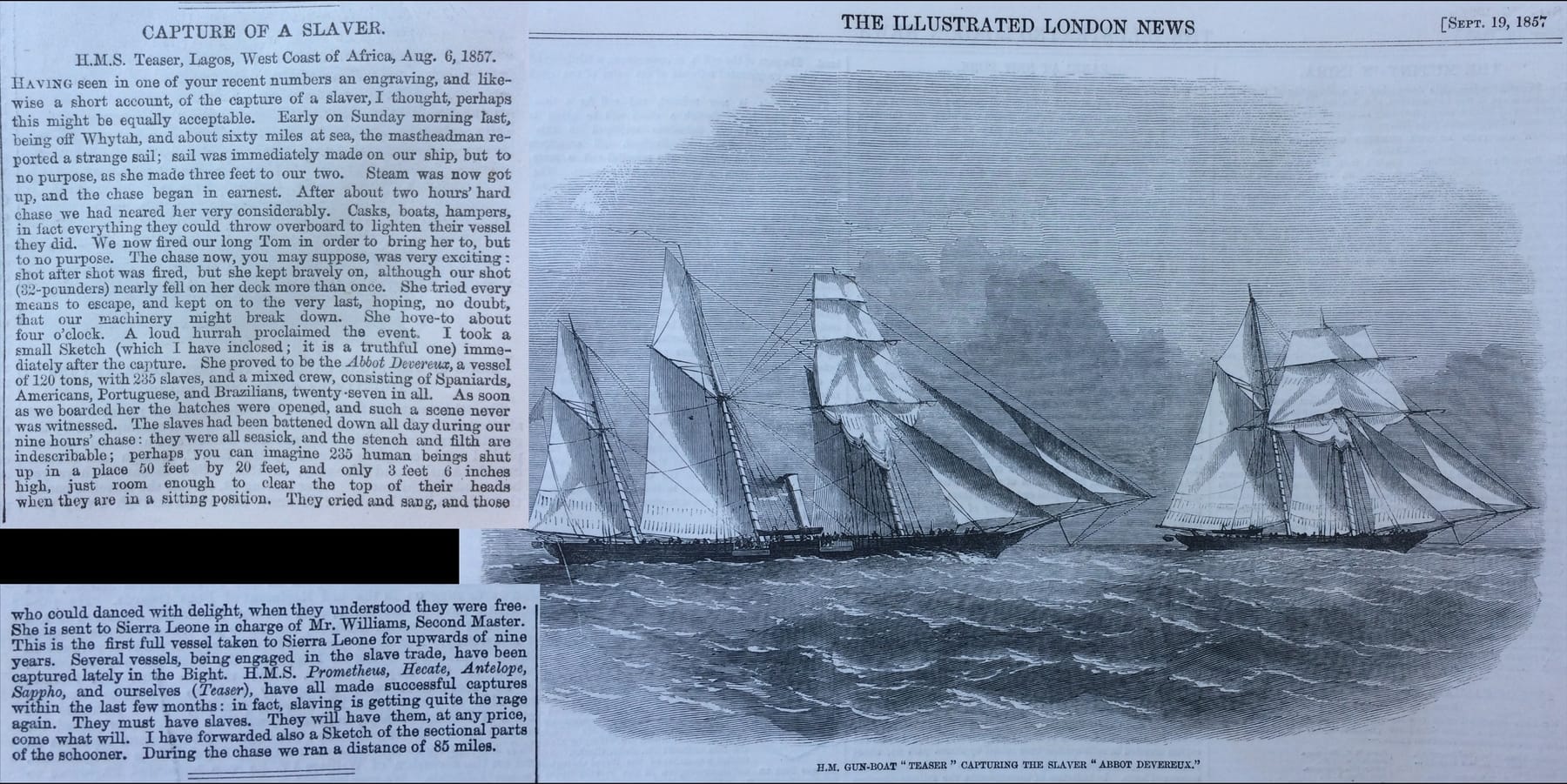
Tales of Derring-Do and Pathos for the Royal Navy’s West Africa Squadron in Late-1857.
In addition to the above report of Her Britannic Majesty’s ship Teaser’s successful pursuit and happy capture of 235 slaves reported in September 1857, the following narrative concerns the tragic and extensive loss of life that occurred during the squadron’s offshore pursuit of the slave ship “Charles.” Bearing a false Baltimore registration, she was actually from New Orleans and easily five or six times the size of the slaver “Abbot Devereux,” pictured at right.
The account pertains to British Deputy Commissioner Edmund Gabriel’s previous item, “List of Vessels using the United States Flag for Slave Trade purposes on the South West Coast of Africa,” perhaps the only officially surviving piece of African ephemera to the tragedy. The dozen ships he listed include remarks about surveillance and apprehension of the “Charles,” entry No. 7, of which he writes, “This Ship had been on the Coast three months waiting a favorable opportunity to ship Slaves and during that time has been boarded by H:M: Steamers “Prometheus” and “Alecto”. She was discovered by H:M: “Sappho” in the act of embarking Slaves at Snakes Head on the 10th Sept and ran onshore to avoid capture.”
This never-revealed story, extracted from U.S. Senate documents on “The African Slave Trade,” from 1858 to 1859, captures, if not the criminals themselves, the negligence and the lengths slavers’ perversity will carry them, as well as their slave-trading accomplices and African natives ashore, who together violently opposed the act of rescuing the ship’s enslaved.
Page 24, in part:
Dispatch to Earl of Clarendon, K.G., from Consul Benjamin Campbell, in Lagos (later Nigeria), August 1, 1857:
“… your lordship will find particulars of an American barque, the “Charles” of Baltimore, boarded by H.M.S. “Prometheus.” This vessel it appears, fitted out at New Orleans; the master made no disguise as to the object of his voyage, … no reluctance in shewing his slave deck regularly fastened down; his twelve dozen men, … and he admitted having on board one hundred and seventy-six leagures full of fresh water [27,000 US gallons], and that he expected to carry off (from Ambriz, he stated) at least one thousand slaves.”
Pages 31-34, in part:
Dispatch to Secretary of the Admiralty, from Rear Admiral Sir F. W. Grey, KCB, commander-in-chief of her Majesty’s naval forces on the west coast of Africa, (No. 61), September 23, 1857:
“I have the honor to inform you that on the evening of the 19th instant [the current month] I received, by the [HMS] ‘Alecto,’ a report from Commissioner Moresby of his having driven on shore a large ship, with slaves on board near Snake’s Head. I ordered Commodore Wise to proceed early the next morning to the assistance of the ‘Sappho,’ and at 8 p.m. the same day, he [Wise] returned, bringing 311 slaves from the wreck. … At 9 p.m. yesterday, [Commander Moresby] joined [us here] and I have received … the accompanying report of his proceedings.
[It] seems to me … this ship is the same that was boarded by the ‘Prometheus’ at Armo You, (July 19, 1857,) although the difference of tonnage is not easy to be accounted for. The ship answers the description and the name ‘Charles,’ of Baltimore, could be partly made out under the paint which had been laid over it. Her tonnage, reported by Commissioner Hope, was 381; Commissioner Moresby is, on the other hand, positive that she was not less than 1600 tons.”To CIC Rear Adm. Sir F. W. Grey, from F. Moresby, commander of HMS Sappho, Sept. 19, 1857:
“… By this time it was evident that the chase [the slaver] could not escape, when her crew ran her on shore, escaping in their boats [or dinghys]. On my arrival I found that Mr. F. Willis … in the whale boat … was using his utmost endeavors to save life. The tremendous surf that was running, combined with the heavy lurching of the ship, (which carried the main top-gallant-mast over the side,) for some time prevented our boarding. After many fruitless attempts, we succeeded.
[S]he proved to be a full-rigged ship, of quite 1,000 tons apparently, full of slaves, having a frigate built main deck, with three separate slave decks; no colors, papers, or name. Her stern was ornamented with a large American coat of arms, the whole of which had just been painted over with white paint.On reaching the deck the sight that presented itself to my view was fearful and heartrending in the extreme. The miserable slaves, escaping in numbers from the noisome hold, rending the air with their hideous yells, and flinging themselves into the sea, were drowned by hundreds, it being impossible to pick up but a few, notwithstanding the whole exertions of all in the boats, who fearlessly, and regardless of their own danger, entered the surf. As soon as possible after getting on board, the remainder of the slaves were driven below and secured under hatches, and transfer[red] to her Majesty’s sloop. … [A]t 10 p.m. … the wind and surf had so much increased that it would have been madness to approach the wreck … and it was with the greatest anxiety I watched through the night for the safety of those on board.
At daylight, on the morning of the 19th, I again despatched the boats to the vessel, but they were warned off [as the] sea at this time was making a clear breach over her. The boatswain [then] reported that large quantities of armed natives were collected on the beach, with symptoms of a hostile nature. I therefore deemed it prudent … to protect the prize [captured ship] if more assistance were required. [The] preconcerted signal was soon made [and] I left … with the boats manned and armed. Soon after leaving, I observed an attack made by a large number of natives, headed by Europeans, supposed to be her crew, and reported afterwards by a Congo negro, who had come off [land] to the ship, to have been assisted by the Portuguese who owned the barracoons [slave pens] close to the wreck. A heavy fire was immediately opened by the boats and [prize-crew] party, which was kept up by both sides for an hour, when we forced them to retreat. [N]o casualties occurred on our side, but with … several [of] the attacking party’s.
[A]s the ship’s back was broken … it was therefore my bounden duty, at all hazard, to remove … the unhappy slaves … and [we] succeeded in getting a rope from the wreck, [and] the remainder of the slaves were hauled through the surf without accident, the small boats keeping up a [return] fire. I then ordered her to be set on fire, rather than risk a second attack. Since capturing the vessel, on the 18th instant, 40 slaves have died from exhaustion and exposure to the wet. Every exertion has been made by the officers and men of this sloop to alleviate their sufferings, all vieing [sic] with each other in acts of humanity, even tearing up their own clothes to cover the naked wretches.The ship was a remarkably fine and superior vessel … [and] the combing of her main hatchway was marked ‘1400 tons.’ From information I have received, she had at the time of going ashore, 1,200 slaves on board. … On the morning of the 20th … the slaves were immediately removed to the ‘Vesuvius,’ and she sailed at 2 p.m. The prize is now totally destroyed, the only parts remaining being the keel and some timbers. The total number of slaves taken [rescued] amounted to 358; 311 were removed [to the] sloop ‘Vesuvius,’ and 7 remained on board this sloop for medical treatment.”
Of the “Charles” reported 1200 captives, in addition to the 40 who died from exposure, we may surmise that up to 882 went overboard to either drown or make it to shore; this in an age when few, even sailors themselves, had learned to swim. In concluding, Commander Moresby praises his crew under duress and reports the drowning death of a coxswain (or steersman), “one of the best men of the ship.” He estimates the armed hostiles they confronted numbered “certainly a thousand … and if obliged to land, every man would have been murdered.”
Shortly afterwards, Commander Fairfax Moresby was severely criticized, in absentia, by the U.S. Congress for the unlawful capture of the American slaver “Panchita,” on May 9, 1857, at Porto de Lenha on the Congo River. He was censured by the Royal Navy and his ship reassigned to the Australian Station. But the “Sappho” never arrived; in February 1858, Commander Moresby and all hands were presumed lost in a great storm off the coast of Victoria.