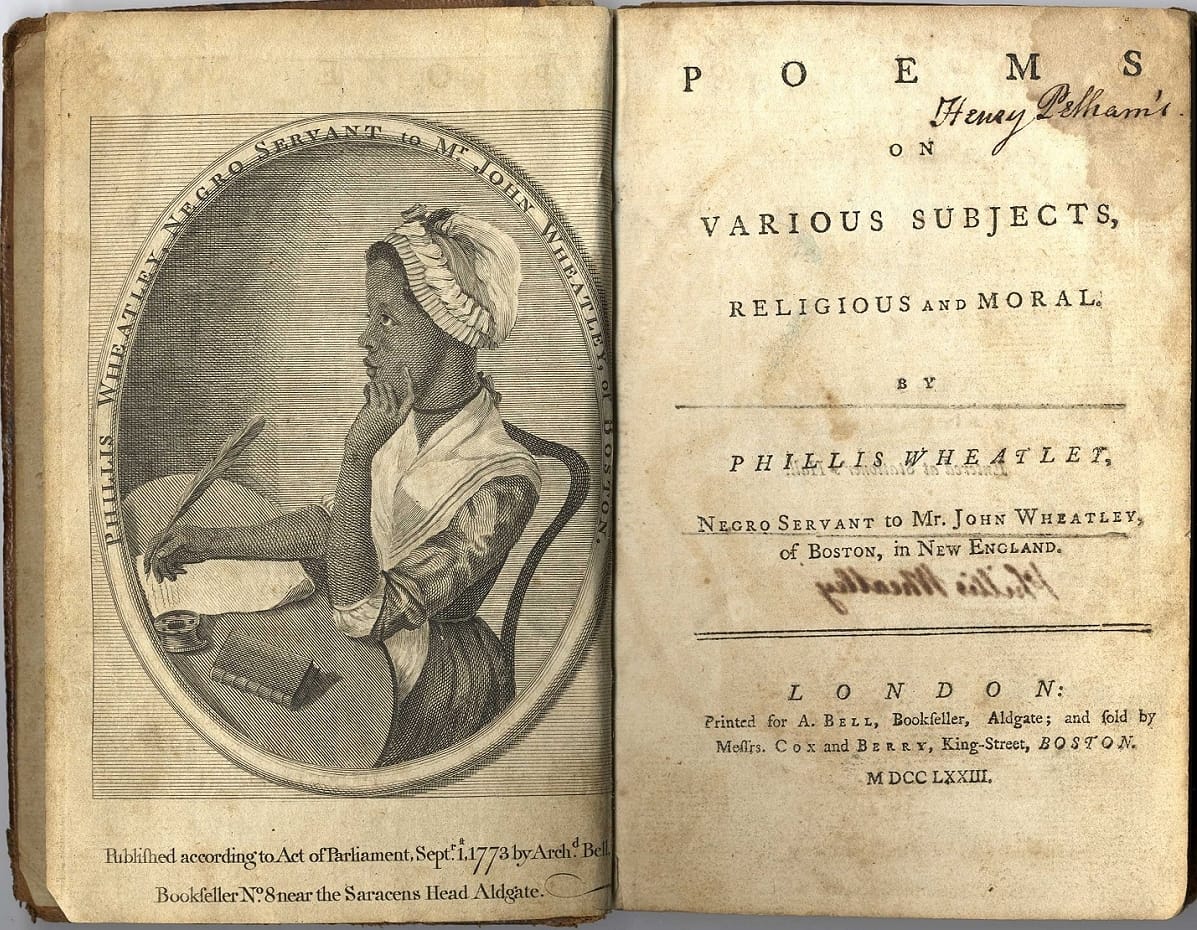
Phillis Wheatley (1753?-1784). A Very Scarce, Signed First Edition of Poems on Various Subjects, Religious and Moral (1773), the critically acclaimed first book written by an African American. Wheatley’s ink signature on verso bleeds through to the title page.
Born in West Africa, this youngster was captured by Senegalese slavers, brought to Boston in 1761 on the ship Phillis, for which she was named, and purchased by John Wheatley, a prosperous Boston merchant, for his wife Susanna. A child prodigy, Phillis quickly mastered the English language, became well-versed in the Bible and Greek mythology and made considerable progress with Latin. She became widely known for her poems and elegies, many which she recited in the homes of prominent Bostonians including John Hancock and James Bowdoin.
Wheatley’s auspicious book, a collection of 39 of her poems, was a surprise in colonial times. Many were skeptical that a 19-year-old black slave could attain such mastery, not only in composition, but in religion. Her collection contains a page listing eighteen of Boston’s intellectual and business elite who were well-acquainted and agreed to vouch for her in 1772. These eighteen men included: the governor, lieutenant governor, treasurer, seven ministers, four poets, and three prominent merchants connected to the business world of London, including John Hancock. Since no Boston publisher would publish her volume, the Wheatleys sent Phillis to England where the Lord Mayor of London warmly welcomed her.
The collection’s London publication was financed entirely by the Britain’s Selina Hastings, Countess of Huntingdon. At age 17, Phillis mentioned the countess in her 1770 elegiac appreciation of the Reverend George Whitefield (included in the book), and was invited to visit her in Britain in 1773. Sadly, the countess took sick as did Susanna, and Phillis was summoned to return prematurely. Nonetheless, publication followed shortly after as did her manumission.
Wheatley was third to Anne Bradstreet in being the first woman to successfully produce an edition of poetry – and her doing so while enslaved and writing her way out of bondage is remarkable. The book was offered in England, Nova Scotia, and mentioned prominently in booksellers’ ads in Boston and Philadelphia, where it reportedly sold well, and is still on the New York Times Best Seller List.
Note the contemporary ink signature of Henry Pelham, the book’s original owner, at upper right. It was Wheatley’s neighbor, Pelham (and not Paul Revere) who accomplished the first engraving of the Boston Massacre of 1770, depicting the terrible scene where Crispus Attucks, the first American, himself black, was felled. And though it’s known Phillis penned a poem about that momentous event, its verses have yet to be discovered.
One biographer maintains that Phillis has truly earned the distinction, “Poet Laureate of the American Revolution.” Contemporary admirers included Benjamin Franklin, Voltaire, and George Washington. Beginning in late-1775, she lauded Gen. Washington as the newly appointed Commander-in-Chief of the Continental Army, not only in patriotic verse but through letters of devotion, encouragement and prayer that he gratefully acknowledged. In March 1776, Washington invited “Miss Phillis” to call upon him at his Cambridge headquarters, however there is no proof the two ever met in person.
Conscious of her talent and status, Phillis remembered the several hundred thousand of her race who were denied opportunity. “In every human breast, God has implanted a principle, which we call love of freedom,” she wrote. “It is impatient of oppression, and pants for deliverance.”
Abolitionists often cited Wheatley and her book to combat charges of innate intellectual inferiority and to promote educational opportunities for African Americans. And later, when Black history was marginalized and forgotten beyond her generation’s collective memory, it would be Wheatley, along with Crispus Attucks and Toussaint Louverture, whom African Americans revered as their transcendent heroes.