The Ill-Fated Freedman’s Savings and Trust Company (1865-1874). An important 1874 letter by Frederick Douglass.
The Freedman’s Savings and Trust Company was incorporated on March 3, 1865 to address the many sad examples of discrimination and mismanagement blacks encountered at local banks. Alongside the Freedmen’s Bureau, it was created by an act of Congress to centralize services to former slaves and their descendants and to help them develop habits of financial responsibility. Unclaimed accounts were to be allocated to educate their children. Most of its eventual 37 branches in seventeen states were run by African Americans themselves. However, by 1874 when Frederick Douglass was made its president, widespread fraud among the upper management and board of directors coupled with the bank’s rapid expansion and onset of national economic instability was proving disastrous for depositors.
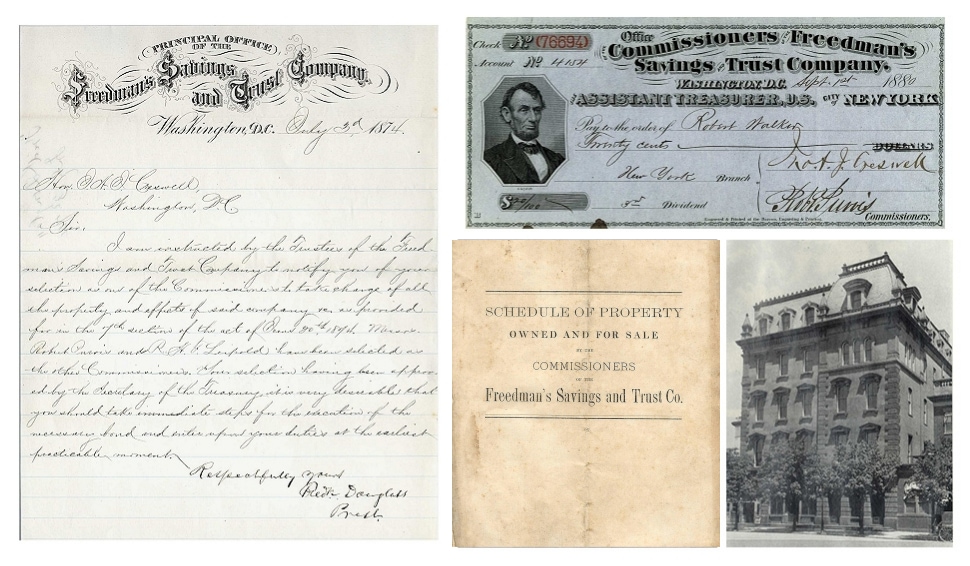
At left, on July 3, 1874, Douglass, as president, writes John A. J. Creswell, the Bank’s third and final commissioner, asking him to assume his new duties and take over the assets of the company. The three commissioners, Creswell, R.H.T. Leipold, and Robert Purvis (the only African American), took charge of the bank’s affairs on July 11th. After just three months as president, Douglass voted on July 1st to close the bank, stating in his 1881 autobiography, Life and Times of Frederick Douglass, “I regarded the institution as insolvent and irrecoverable, and that I could no longer ask my people to deposit money in it.” The bank was officially closed the following day owing to insolvency. Black depositors lost an estimated $3 million in savings. In a last-ditch attempt to stabilize the failing institution, Douglass himself lost $10,000 of his own funds (equivalent to $200,000 today).
At top right, this unclaimed Freedman’s check for a mere twenty cents and signed by Creswell and Purvis, was part of the last of three declared dividends (Sept. 1, 1880), under the administration of its commissioners. However, it was difficult to locate the many thousands of depositors and some 40,000 dividends went unclaimed.
At right, a photo the Bank’s central office in Washington, DC, and at center, a scarce pamphlet from the bank’s commissioners listing all the property to be liquidated after it became insolvent.
For generations, blacks would remain cynical about the banking industry.